Monday, July 27, 2015

"The Tragedy" - a response in verse to Picasso's 1903 painting.


Unrelieving, infinite hues of blue suffuse,
Lap at despair,
Shudder through him,
Claim her,
Confounding their child.
All statued; paralysed:
Triptych of Tragedy.

Barely alive,
Lit by the world’s last candle,
Hunched and held
Bemused, they reel
In an intolerable spell:

While silent, whitened ripples ice and bleed.

[Ray Wilcockson, July 2015.]


© Ray Wilcockson (2015) All Rights Reserved.

Sunday, May 31, 2015

"The Speckled Band" - A Simple Act of Charity. New Year 1911.

Readers of Sherlock Holmes may be interested in a theatre programme I recently acquired that records an unusual occasional performance of Conan Doyle's adaptation of The Speckled Band. This post shares its content and attempts to provide some context.

1) The Pretoria Pit Disaster. 


Postcard of the Disaster (John Sharples later died).
At 7.50 am on December 21, 1910 an explosion occurred in the No 3 Bank Pit, Hulton Colliery, Westhoughton, Lancashire, that shocked a nation preparing for Yuletide festivities. It proved to be one of the worst mining disasters in British history. The Parish of Westhoughton website has an excellent account HERE & may be supplemented by the moving story of survivor Joseph Staveley recorded HERE .

As these accounts detail, a fund was at once set up to support the many bereaved families and, even as more of the dead were being recovered, Sheffield was in the vanguard in arranging a charity matinee of entertainment at its Lyceum. Under the Immediate Patronage of the late Queen's third and fourth daughters (then in their 60's), the local Telegraph Mayor, (new) Master Cutler (Arthur Balfour) and others supported an ad hoc committee of Sheffield theatre managers. It is testament to their commitment and the tragedy's impact that such performers as Lillie Langtry and Seymour Hicks were engaged gratis at such short notice.
Part 1 of the Matinee Programme
2) The Speckled Band.

At the time of the Pretoria disaster Conan Doyle was home at Windlesham with a special Christmas to celebrate. Adrian had just been born (on November 19) and would be christened on the second day of 1911. Notwithstanding this preoccupation, his permission is sought and given to include a version of his latest theatrical success in Sheffield's matinee of the 5th.

After the failure of The House of Temperley Doyle's hurriedly adapted short story had more than averted potentially heavy losses in leasing The Adelphi. Saintsbury's Holmes and Lyn Harding's Rylott had packed the theatre from June until the play's transfer to The Globe in August. That equally well-received show had closed by the end of November. In America, the less successful production starring Charles Millward would fold on December 17, after brief runs in Boston and at New York's Garrick. 

The play was due to commence a new season in 1911 under Arthur Hardy's management at The Strand. The popular Lyn Harding would return along with Christine Silver as Enid Stoner. A new Holmes for London theatregoers, O P Heggie, performed the role from February 6-25, primed with a note from the author (see HERE ). 

It is perhaps less well-known that Arthur Hardy was already touring a company that had, for example, played the Edinburgh Lyceum from 5-10 December, 1910. A playbill survives in Glasgow University's Special Collections. Holmes is Julian Royce (back in the role he played when touring the Gillette/Doyle play) and it is from this cast the Sheffield contingent was drawn (see HERE ).  


Part 2 of the Matinee Programme
Seven members of the touring company travelled to Sheffield for the afternoon to play The Baker Street Scene. In Doyle's play this is Act 2, scene 2. An online version of The Speckled Band may be read HERE . This omits Mrs Soames who is another client in other editions. Two striking omissions will be observed: Milverton is excised and of course where there's no Act 3 there can be no snake!


Julian Royce
I'd say the scene stood up well enough on its own terms offering the iconic detective in reassuringly familiar situations and surroundings. Apart from the practical need to keep things simple, perhaps this was not in any case a time for melodramatic horror. There was enough real horror in the adjoining county.

Andrew Lycett notes in his biography (p 345-60)that ACD kept a lump of coal in his study that he joked he'd gladly drop on his toe if visitors conceded there was coal in Kent ( a favoured, failed investment). I'm sure it took on a more sober meaning after Chrismas 1910.

3) Some Matters of Related Interest.

The Billboard for October 15, 1910 has an article about Charles Frohman's new production for the Boston theater in which Conan Doyle is reported to have promised to attend "the first performance of his play wherever it is presented in America" (see HERE ). I doubt he ever saw this as a feasible prospect. 

My American friend, Sherlockian Howard Ostrom, may be intrigued to learn (or did he know?) that Gilbert M (Bronco Billy) Anderson is not the only early cowboy star with a Sherlock Holmes connection. While researching I came across a reference to the early rehearsals for Frohman's "The Speckled Band": Ronald L Davis notes in his "William S Hart: Projecting the American West" (see HERE ) that Hart was hired to play Holmes in The Speckled Band but quit after one week's rehearsal, "sensing that the show was heading for disaster". In the event, Charles Millward occupied Baker Street in Boston.

Later in 1911: While, in England, A Corney Grain is known to have played the detective in The Speckled Band  on May 8 at the Southampton Grand, William Desmond began a lengthy tour of Australia and New Zealand in August for the Williamson Company.

1914: The Sydney Morning Herald for 25 April reported the imminent appearance of Julian Royce in the role made famous in England by Matheson Lang: Harry Vernon's "Mr Wu". (see HERE ). This article is of further interest in describing Charles Millward's career and current introduction to Australia.

 Royce seemed fated to follow in more famous footsteps but there is an interesting comment on his Holmes in The New Zealand Herald of 16 May 1914 (see HERE ) suggesting "the British press spoke of him as the best Sherlock Holmes ever seen". 

Julian Royce in the Gillette "Sherlock Holmes" at Kennington Theatre.
  
© Ray Wilcockson (2015) All Rights Reserved.


Monday, May 25, 2015

Return to New Street - Birmingham in the Sherlock Holmes Canon.


Birmingham and Aston.

I hear of Sherlock in unlikely places. There exists an establishment in Birmingham's Corporation Street I have not had reason to visit whose website addresses "Sherlock Holmes trivia buffs". I wonder if its manager is a florid-faced, elderly gentleman , with fiery red hair...

Today, Corporation Street extends from New Street and its station for some two miles all the way to the site of Conan Doyle's home circa 1880. Clifton House, Aston Road is long gone, along with much of the Victorian city. A blue plaque, erected by the civic society, commemorates the author's residence in what was then still a village.

These were formative years for Conan Doyle: as doctor, writer and man. He turned 21 as ship's surgeon aboard the Greenland whaler, Hope, during the first of two maritime adventures that punctuated extended periods in Aston as medical assistant to Dr Reginald Ratcliff Hoare who treated him more like a son than an employee.

My sense is that Hoare persisted for Conan Doyle as one of those fixed points welcome in any life. In its report of his death in 1898, the BMJ notes Dr Conan Doyle was "one of those who sent tokens of their respect". ( see column one ). The family was represented at Conan Doyle's wedding to Jean Leckie in 1907. Hoare lives on as the inspiration for Dr Horton in "The Stark-Munro Letters"...and both doctors perhaps in Sherlock Holmes's identical morning habit of smoking the dottles of a previous night's pipes. 

Birmingham would never be forgotten and just now and again finds its way into the Sherlock Holmes stories. 

The Gloria Scott.

"There had been a daughter, I heard, but she had died of diphtheria while on a visit to Birmingham." 


A poignant creation, Victor Trevor's nameless sister. Her passing mention has no plot significance but along with a deceased mother and the father's fate plays out a retribution for the original sin and leaves Victor alone in the world. 

As to the girl's particular fate, it parallels the irony of her father's - riches are no protection in this life. This is no child of the slums; diphtheria (that great leveller) takes her as readily, far from home.


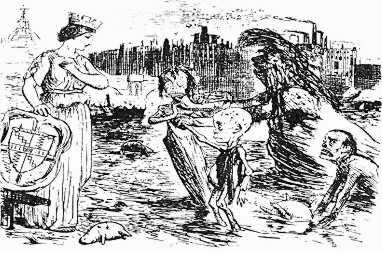
River Rea shows her 3 children, Cholera, Typhoid & Diphtheria to Birmingham.

The story's internal evidence places Holmes at Donnithorpe "more than twenty years" after The Gloria Scott episode of 1855. 
Thus, in late 1892, Doyle writes essentially of Hoare's Birmingham which had endured an outbreak of diphtheria in 1871-2 and was currently bracing for a steep rise in fatalities that would peak in 1895. For me, and I suspect Dr Doyle, Victor Trevor's unnamed sister stands for thousands like her. 

The Three Gables.

"I was trainin' at the Bull Ring in Birmingham when this boy done get into trouble."

Steve Dixie is, of course, transparently lying. Holmes knows it; Dixie knows he knows it. Given the bruiser's slow wits and lack of education it is amusingly feasible to imagine he here trots out his stock alibi blissfully unaware that city's Bull Ring was (and still is) essentially a market.
Bull Ring Market, Birmingham c 1905.
 It is just as likely, however, that some of the city's boxing gyms were located in the area. Moreover, Conan Doyle appears to have kept in training during his tenure in Aston. We know he had "two pairs of battered and discolored gloves" with him on board The Hope, where he, famously, gave steward, Jack Lamb, a black eye.


Sreve Toussaint as Steve Dixie (Image Granada TV).

What is certain is that both Doyle (in 1880) and Steve Dixie (circa 1903) would need all the pugilistic skills they could muster in a Birmingham rife with gangs such as the notorious Peaky Blinders. 

The Three Garridebs.

"Howard Garrideb Constructor of Agricultural Machinery Binders, reapers, steam and hand plows, drills, harrows, farmers’ carts, buckboards, and all other appliances. Estimates for Artesian Wells Apply Grosvenor Buildings, Aston."

Doyle would be as familiar with Grosvenor Road in Aston as Sherlock Street in the city centre. Eventually, Corporation Street becomes the Lichfield Road beyond Aston Rd North and Grosvenor is by the railway station. 

So, the hapless Nathan Garrideb is packed off to a strange city 100 miles and two hours away having taken no such journey in years. There are, of course, striking similarities with REDH and STOC. In essence all three are cautionary tales ( as is ENGR). In such cases the only sensible action any of these clients take is to consult Sherlock Holmes.

Birmingham is ideal for Doyle's purposes and it is not surprising the city still calls to him in 1925  for another of its worthies has remained a constant reminder of it in the author's life: Joseph Chamberlain.

Though never Prime Minister, the Londoner who migrated to Birmingham to make screws was a towering political figure throughout the three most active decades of Conan Doyle's career (in Churchill's phrase "the one who made the weather"). The two lives converged most closely in the Boer War and during the author's failed excursions into politics. But they had passed like ships in the night long before. 
1906 postcard for Chamberlain's 70th Birthday.

The Stockbroker's Clerk.

"You are ready to come to Birmingham then?" 

Though set more than a decade apart, STOC and GLOR stand together in The Memoirs and draw on the common memory of Doyle's Midlands interlude. The former is the Birmingham story of the Canon, uniquely bringing Holmes and Watson to the streets their creator walked. 


Looking up Corporation St from New St c 1904.

The chronologers date STOC to 1888/89. For years I have mistakenly pictured 126b, the offices of the phantom Franco-Midland Hardware Company, Limited, as Dickensian in age and character. In fact, Corporation Street was barely ten years old in 1888 and would not be completed until 1903. By the time Doyle arrived, ex-Mayor Chamberlain had been elected to Parliament, but his ambitious plan to cut a swathe through the slums with a great boulevard stretching from New Street had been accepted in '76 and begun in '78. Given its number, the fictional office would be one of the newest built and likely awaiting first occupation.

Hall Pycroft relates how 'Mr Arthur Harry Pinner' suggested "a couple of hours at Day's Music Hall in the evening". 


Day's Crystal Palace 1890 programme (image Arthur Lloyd)

Day's Crystal Palace Concert Hall (later The Empire) was on the corner of Smallbrook St and Hurst St in the city centre. Opened in 1862, the name changed to Day's Crystal Palace of Varieties in 1887. It would close in September, 1893, six months after the publication of STOC. Just the place a young doctor's assistant might seek entertainment in his brief periods of leisure. 

A Tale of Two Cities & Dual Identities.

"He swears by London you know, and I by Birmingham."


The Stockbroker's Clerk may not aspire to comet vintage in the Canon but it possesses an artful symmetry of plot, character and setting, stylistically suited to a whimsical but cautionary parable of the human comedy. There is no iconic scene such as REDH offers in the bank vault; no classic moment of deduction on a par with the dog in the night. Holmes, with almost as little to do as in ENGR, is rather in connoisseur mode, chronicling (with Watson) one of those outre tales that everyday life occasionally presents. It is this kind of story and, aptly, if less comical, Pinner's tasks for Pycroft are pale and unimaginative beside Jabez Wilson's encyclopaedic marathon.
"Nothing could be better," said Holmes.

In keeping with its prosaic nature, the story opens not in Baker St but in the domestic setting of Watson's Paddington practice. Doyle takes pains to endow Hall Pycroft with idiom and vocabulary authentic to his city milieu. 

The railway journey serves two functions: its dramatic duration coincides with the clerk's relation of events and, symbolically, it represents a voyage (taken by the three travellers and the reader) from darkness to illumination.

Birmingham proves a place of ironies. In 3GAR it is merely somewhere distant to park Nathan while Killer Evans retrieves the hidden press. Here the city functions as a siren to the clerk's credulous greed and as the place of (mild) penance. It is mere good fortune (with the support of Sherlock Holmes) that he is not stung more seriously than toiling through trade directories for several nights in a New Street hotel.

For the Beddington brother who deceives Hall Pycroft, Birmingham had, similarly, seemed a cunning, inspirational plan. Ironic and retributive indeed that he should go to all the trouble and expense of renting offices and disguising himself only for events in London to confound him utterly.

One of the subtle beauties of this story lies in the way it plays with identity. It is quite the prose Comedy of Errors. Consider. One Beddington poses as both Arthur Pinner and his brother, Harry. The other (the murderer) assumes Hall Pycroft's identity. As Holmes concludes: "Human nature is a strange mixture, Watson. You see that even a villain and a murderer can inspire such affection that his brother turns to suicide when he learns that his neck is forfeited". Ironically, only then are the Beddingtons inescapably themselves.

Doyle has Shakespearean fun with this meme of dual identities and cannot resist including Holmes and Watson.
The former is presented as an accountant to Arthur Harry Pinner, the latter as a clerk. We should not miss (Watson doesn't) that Hall Pycroft can formulate a lie rather too easily for comfort. It is he who suggests the ruse of introducing "two friends of mine who are in want of a billet". And one senses Watson's disquiet in "One is Mr Harris of Bermondsey, and the other is Mr Price, of this town," said our clerk, glibly." 

Perhaps Sherlock Holmes and Doctor Watson provide the "Blade Straight, Steel True" image of true brotherhood.

                                                *******


The train awaits. It's goodbye Birmingham. Next stop Euston!

Further Reading.

Day's Crystal Palace: Arthur Lloyd Site Entry    
Doyle in Birmingham: Birmingham City Council Entry 
Joseph Chamberlain
Improvement Scheme: The Iron Room Entry 
Early Municipal Housing
in Birmingham:              Municipal Dreams Entry 


© Ray Wilcockson (2015) All Rights Reserved.


Monday, February 23, 2015

Selkirk's "Lost Sherlock Holmes Story" - A Case of Literary Identity.

Illustration by Sidney Paget.


"Look at that with your magnifying glass, Mr Holmes."

The Norwood Builder.


The revelation of a hitherto unrecorded story featuring Sherlock Holmes and Doctor Watson has been attributed widely and prematurely to the authorship of Sir Arthur Conan Doyle. "Sherlock Holmes: Discovering the Border Burghs and, by Deduction, the Brig Bazaar" may be read in its original entirety in The Daily Mail 20 February, 2015 whose article details the circumstances of the discovery with a headline that cannot be taken as gospel, certainly not according to the website "I Hear of Sherlock Everywhere" whose prompt survey of extant contemporary documents concludes Conan Doyle Didn't Write the Lost Sherlock Holmes Story. 

In his comment on a lucid article by Mattias BoströmLeslie S Klinger finds his fellow Sherlockian's analysis "persuasive" though he is not sure it is "conclusive" and notes "there is much work still to be done".

In that spirit, I propose here to put the story itself under the magnifying glass for signs of Conan Doyle's literary fingerprints. Could he and would he have written it?

A Narrative in Three Movements.

1) The reader is addressed by a nameless narrator tasked by the Editor of "The Bazaar Book" with writing a topical "interview" with "Sherlock Holmes" for its Saturday edition. Rejecting unviable alternatives, the Editor's hint that resourceful journalists use their imagination is readily taken up.

2) The narrator describes the process of imagining an entry impossible in reality into an imaginary room containing (imagined) Holmes and Watson. Shifting into the present tense, warming to the creation of palpable fancy, our narrator asserts arrival just as Watson is leaving for the night after a heated discussion on fiscal policy.

3) Signalling the start of an extended imaginary dialogue between detective and doctor (with the dramatic abbreviation "loq" (for 'loquitur'), the narrative voice all but mutes in a story only a quarter begun. There follow two imagined passages of deduction, triggered by the invention of parallel trips to Scotland: that Watson's destination is the Borders for "another Parliamentary contest" and that the bazaar he is to open is in aid of a bridge. Holmes bids his friend a teasing farewell. Finis.

Discussion of Authorship.

I set out here to clarify the implications of claiming Sir Arthur Conan Doyle wrote this 1300 word occasional piece. If he did, it would (chronologically) be the second of three, flanked by The Field Bazaar of 1896 (1050 words) and 1923's How Watson Learned the Trick (500 words). These are closer comparisons to consider than the Canon stories proper. I shall look first at the narrator framework and then at the deductions dialogue.

A Unique Device.

If A N Other wrote the Selkirk story it is possible its narrator is identical with the author (ie: a 'reporter').
Attribution to Conan Doyle, however, necessarily renders the narrator an invention unique in his Holmes oeuvre. {I can envisage no commentator who would seriously argue Doyle wrote the deduction sequences and acquiesced in a narrative framework by a different hand.} By 1903, Holmes has his resident Boswell, a proven device only departed from on the few occasions the detective tells his own story and recourse with good reason to third person narration. "The Mazarin Stone" is a prose adaptation of the play "The Crown Diamond"; I discuss the special case of "His Last Bow" HERE and, while, strictly, the brief "How Watson Learned the Trick" is third person narrative, it's mostly continuous dialogue. Doyle is content to entrust the narrative of "The Field Bazaar" (the closest parallel for the Selkirk piece) to Watson.

I can suggest no artistic reason why in December, 1903, Conan Doyle would make so radical a departure, the more radical given his current imaginative absorption in "The Return" stories. If he could slip effortlessly back into a Watsonian narrative in 1896 for one solitary bazaar piece, I'd be surprised if he abandoned the good doctor in '03.

If the 'reporter' is Doyle's creation two related literary problems arise: the narrator's characterization and the presentation of Holmes and Watson. Apart from the first two movements delaying the appearance of this interview's subjects, the narrator's blatant stress on imagination effectively forestalls any suspension of disbelief as surely as Shakespeare's 'rude mechanicals'. Were an imagined interview to ensue (it doesn't), it would be stillborn. The greater the insistence that imagination can pass through closed doors the less the reader is transported anywhere. In short, we have a naive narrator rooted in one world with no credible presence in that inhabited by the insubstantial shadows claimed to be Sherlock Holmes and Doctor Watson.

Even when, in the simplistic jar to present tense, the famous pair are invoked, like spirits conjured, they barely enjoy a half-life. There is no interview; there is not even an overview by our intrepid, unperceived reporter. There is far too much blocking the reader's imaginative view of anyone resembling Doyle's creations. First it is the self-conscious, clunking presence of the narrator; then, throughout the deductions dialogue, such a fusillade of political reference and literary allusion that both Doyle's characters and the skill of deduction are demeaned: the former puppet mouthpieces for the Tariff debate; the latter a washing line on which to peg a motley selection of Border literature.

To keep this discussion clear, I have appended notes on specific allusions to the politics of the day and sources from which the Border references are drawn. I would just stress that I see nothing with which Conan Doyle might not reasonably be familiar. By the same token, the good folk of Selkirk would be as well up on the national Tariff debate and positively steeped in their local cultural heritage. It is not this content that is significant to the question of authorship but the use to which it is put.

Joseph Chamberlain's Free Trade & Tariff Loaves Nov 4, 1903.

To be invited without preamble to envisage Holmes and Watson as Free Trader and (mild) Protectionist is to be jolted into an unfamiliar personal political arena alien to the Canon. Indeed, that Sherlock Holmes rises above such partisan concerns is arguably presented as an occupational necessity to maintain objectivity. Holmes's reference to the "Mysteries of the Secret Cabinet" is but the first in what will prove to be an inordinately lengthy chain of strained attempts to relate the writer's real interests (politics and the Borders) with detective fiction. "The Tragedy of a Divided House" will, later, play as unsubtly on the recent "Return" story title.


The Norwood Builder - a special problem.


Before examining the overall quality and impact of the deductions, it is instructive to highlight an analogy employed drawn from "The Norwood Builder" in which Holmes refers to "retailing (to Watson) the steps that led up to the arrest of the...builder by the impression of his thumb."

Now, as well as the addition of a "lilting" Watson, this is a fabrication. More seriously, the narrative logic locates the Selkirk story and deductions firmly in 1903. The Canon story is set 8 or 9 years earlier, mere months after the detective's Return.

Anyone claiming Doyle wrote for the Brig Bazaar must contend with:
1) A deliberate or forgetful misrepresentation of a story published but a month earlier.
2) A calculated or thoughtless abandoning of Canon chronology.

I shall not rehearse the totally valid reasons why Frederic Dorr Steele knowingly deploys artistic licence in his cover design for "The Norwood Builder". The anonymous author's misrepresentation is another matter. There are plenty of analogies in other stories that would accurately have suited the occasion.

Deductions.

The first passage of deduction reveals how, over several days of observation, research and thinking Holmes knows without being told that Watson is heading for the Border Burghs with a view to standing for parliament again. 

In the process of deducing the doctor has (in order) Hawick, Galashiels and Selkirk on his mind, we encounter a Holmes who observes only in so far as he listens, one given to such disproportionate research as writing to a friend miles away for an obscure tome. This Watson is vociferously political and so ambitious of a candidacy he mugs up on Border politics, history, music and literature. Both characters are diminished from what is usually an iconic exchange. The prospect of this pair passing the evening in a drawing room with a mutual lady friend could only occur in a Street called "Sloan"; never "Baker". Nor does a tin of tobacco, smoked in the cloak of night pass muster as the last link in a chain of deduction. 

In truth, we haven't really witnessed a classic Sherlockian deduction - a couple of lazy 2's have gone through the motions of making 4.

Devoid of true inspiration, 'deducing' the bridge turns again on a literary allusion at the expense of Watson's dignity and without illustration of the detective's extraordinary powers. I say "Watson" but he has faded long before, supplanted by someone resembling Sir Arthur Conan Doyle. I would just add that if, as I shall presently argue, A N Other wrote this bizarre Bazaar piece, I detect a local voice in the teasing threat that "fearful odds" await aspiring politicians from the no-nonsense electorate of the Border Burghs and am irresistibly reminded of Richard Hannay's intractable audience.

Self-Parody.

This is a rarer genre than parody and self-parodies of real quality even rarer. Such is the context for my final discussion of a story that would be unique in Conan Doyle's writing, surprisingly unsuccessful and most strangely hatched in an alien style. I should advise anyone considering the authorship of this piece to read it alongside "The Field Bazaar". The 1896 deduction of Watson's invitation to support his alma mater's cricket club is far superior and no parody. The term is I think sometimes applied because of its brevity, wit and lightness of touch. In essence, however, though the bazaar provides a theme, Conan Doyle faithfully breathes immediate life into Holmes and Watson of Baker Street, imbuing the train of reasoning with all the ingenuity he brings to the Canon proper. This detached scene would dovetail effortlessly into a conventional Holmes story. As ever, Conan Doyle's first concern is his art. He is in this uncompromising, even (especially) in the story designed to 'kill' his creation.

"The Field Bazaar" is an occasional piece evincing a generous, lively, lighthearted spirit enjoying the task but not at the expense of the imagination's dignity. The prose is consummate in its pellucid economy, the authentic dialogue fully realising character. In short, it is proof positive of what Conan Doyle is prepared and equipped to offer for such special occasions.

I detect a very different kind of mind informing the Selkirk story. It feels antiquarian in attitude and language. The drama and poetry of the 18th Century and Border history centered on Flodden Field are the limited province of a writer who understands next to nothing about imaginative fiction.

I see no sane reason why Conan Doyle should take on such a persona. Indeed, I believe him incapable of it. This is the writer who is, in 1903, taking infinite pains to assemble a series of Holmes stories of the first order. He is happy NORW meets the standard, not so content with December's SOLI. With regard to the forthcoming trip to Scotland his letters to Mary Doyle tell of a similar,  deeply serious concern to get his election speech just right. That is how he hopes to sway the Border electorate - not with an ingratiating self-parody. 

One of the most admirable qualities Sir Arthur Conan Doyle possessed was an enviable capacity to keep multiple interests and projects in the air at the same time in disciplined compartments. Whatever he commits to is done with full-blooded, indefatigable energy, devoting all his considerable skills. It would be unbelievably perverse for such a man to completely undermine an imaginative world for the sake of a seat in Parliament or a Border brig. To modify the words of Sherlock Holmes at the end of The Field Bazaar: the Border episode was one of those small outlying problems to which Conan Doyle was sometimes tempted to direct his attention.

I assume he opened the Saturday bazaar; I know he made his Selkirk speech. I'd think the less of him if it's ever proved he wrote this travesty.

 Sherlock Churchill berated by an Oldham Mrs Hudson? "You are the most destructive lodger I ever took in!"
                          
Notes.
Lord Goschen championed Free Trade in 1903. Joseph Chamberlain's biography (p294) describes his use of the Martello tower image (in common use): 

"Are you to take foreign tariffs lying down ? ' the advocate of the 
new policy had asked. ' Lying down ' became one of the familiar 
phrases of the fiscal school ; it was tossed backward and forward. 
Lord Goschen played with it in the Queen's Hall : ' What do these 
warlike champions recommend us to do ? To stand up ? No ! but 
to crouch behind a wall. British trade was no longer to sally forth 
and meet the foe, but to build fiscal martello towers around the coast 
and arm them with guns which were spiked forty years ago ! ' Thus 
the veterans fired into one another, and although there was not yet 
so much bitterness as in the case of the Home Rule split, gibes were 
sometimes used which caused resentment."

"Huz" means "we" and is listed in The Roxburghshire Word-Book 

"Teribus" - Teribus Ye Teri Odin 

"Common Riding" - Hawick and Selkirk 

"Flodden Field" Flodden and Selkirk

"Flowers of the Forest" - Link 1 and Link 2

"Braw Lads" - Braw Lads O Galla Water

Final Note: It is just possible that (to a Scot) the reference to a "Secret Cabinet" calls to mind a collection of erotic verse and bawdy song written by Robert Burns called - The Secret Cabinet or Merry Muses of Caledonia . This would raise the fascinating   question of what Sherlock Holmes may really have been up to in  Edinburgh!


© Ray Wilcockson (2015) All Rights Reserved.


Saturday, January 10, 2015

Sherlock Holmes Spotting (Part 4) - Wanted for Questioning.


No case is cold in Sherlockian investigation and I therefore close this series of Sherlock Holmes Spotting with a small group of performers who have proved especially elusive. All are known to have impersonated Mr Sherlock Holmes but their files are regrettably slim. Hence, I detail here what little is known in the hope more in the way of biographical information, sightings, even photographs may come to light. Please report any new information here or to your nearest Sherlockian.

John Webb.

Our first fugitive is known to have been active in the Glasgow area in the late Spring of 1894 with confirmed sightings (at least for a week) from May 28 when, with numerous accomplices, he masqueraded as Dr Conan Doyle's detective upon the stage of the Theatre Royal
Glasgow Herald June 2 1894

The second person ever to portray the Great Detective, he did so in conspiracy with Mr Charles Rogers whose play, "Sherlock Holmes: a Psychological Drama in Five Acts" had claimed stage copyright through a performance at the Theatre Royal, Hanley in December, 1893. An eye-witness from The Era reported John Webb played the part "earnestly and with much success" and secured a valuable list of his accomplices:


St. John Hamund (Dr. Watson), Arthur Lyle (Wilton Hursher), C. M. Curtiss (Augustus Featherleigh), Roy Cochrane (Dr. Macfarlane), Hugh Nolan (Dr. Grant), Mr. Conor (Mr. Westlake), Philip Rooke (Thompson), James Mayall (Jones), Kenyon Lyle (Billy), Mr. Quartermain (Lord Chief Justice), Mr. Bowes (Groves), Mr. Archibald (Rev. Mr. Williamson), Mr. James (Hawkins), Mr. Watson (Cotton), Mr. Constable (Police-Sgt. Thomas), Phyllis Manners (Mrs. Watson), Edith Lewis (Ruby Hursher), Jenny Hicks (Jane), Elaine Turner (Rachel), Cissy Sephton (Lily).

To these must be added one Henry Cordyce who, in concert with Hamund, managed the operation. Cordyce and Rogers have past history as the 1000 Reward Company active in 1893, a prior association that, with further research, may yet yield some trace of Webb himself.

I seized my Thread.

Arthur Lyle (Wilton Hursher in the play) has served as a fresh trail to follow...initially to Brighton in 1889, where he was recognised upon The Royal's stage in the guise of Justinian in Monday, November 18's premier of "Theodora".

The drama is an English version of Victorien Sardou's original (famously acted by Bernhardt), written by Robert Buchanan for the American actress, Grace Hawthorne (Nathaniel's niece) who purchased the rights from Sardou. The notes that follow are extracted from the excellent Robert Buchanan website (see HERE ). 

In this lavish production (it boasted two tame lions on stage), Lyle had as fellow actor Fuller Mellish who would, years later, appropriately, appear as Sidney Prince in Gillette's Lyceum "Sherlock Holmes". Neither actor tours with the company for much of 1890. Mellish is back (and admired) as Andreas, the Greek, from September.

The Stage for 19 February, 1891, reviewed the play's first night at London's Pavilion. On stage with Mellish is a new addition to the cast, playing "the illustrious general, Belisarius" - John Webb is described as "commendable". 

By the time the play opened in Newcastle-upon-Tyne (as detailed in The Stage for 23 April, 1891) Webb has been promoted to "an excellent Justinian". 

Though not specified in The Stage's brief review of a Dublin Gaiety engagement (28 May), I take it John Webb was still in the cast at that time as his subsequent departure is commented upon in The Stage's review of the resumed London run at The New Olympic (6 August).

The Observation of Trifles.

Where minimal data exists as in the case of the elusive John Webb any morsel, however insignificant in itself is worth noting: "docket it", Holmes himself advises.

I do not know if this is the same John Webb: I think it at least possible, given the thread followed here and the sense that he would, by late '93, be a known, experienced candidate for Sherlock Holmes. I have only scratched the surface of these lines of inquiry and see two main directions for the future: the much better documented  Robert Buchanan archive may have preserved images of Theodora putting a face to Webb. There's also all the reason in the world to investigate that whole list of accomplices for more possible sightings of our elusive thespian. Meanwhile...

Bessie B Beardsley.

Time to call in Pinkerton's for my next thespian wanted for questioning inhabited that shadowy, glitzy world of turn-of-the-century American vaudeville. I give you Bessie B Beardsley, who, anonymous as she remains, would appear to be the first female to impersonate Mr Sherlock Holmes in any media. Here's what I know (and it's not a lot!) about the original Baker Street Babe.


Proctor's 5th Avenue Theater 1899
Not to be confused with Edison's (later) film "Miss Sherlock Holmes" starring Florence Turner, "Little Miss Sherlock Holmes" was a one-act vaudeville sketch, performed at Proctor's 5th Avenue Theater in early July, 1900.

Written by J Searle Dawley it was presented by and starred Sheridan Block as a highwayman. Set in the present in London, Block's three accomplices are the author, Harry Vaness and Ms Beardsley. Advertisements appeared in the New York Times (8 July) & the Indianapolis Journal (10 July) ( see HERE and HERE )

The fullest description that places the sketch in its vaudeville context appeared in the New York Clipper on 14 July. I reproduce it below.


As yet, no photograph or further information has been detected.

Hugh Robinson.

On September 20 1911, five days after the death of Thomas Kingston (see my previous post), London's Kingsway Theatre hosted (for 2 performances only) "Sherbet Jones; or Who Stole the Roller Skates" with Hugh Robinson (Sherbet Jones) along with Ernest Thesiger (Dr What's On) & Miles Malleson (Professor Goryarty).

The London Evening News reviewed it the next day (see HERE ).
Robinson is described as a "Cambridge Humorist"  who has put together "an undergraduate's lark" which includes a satire on musical comedy "The Girl with the Cash" and his "Sherbet Jones". He plays the famous detective "well...very youthful". We are told his little company includes a capable eccentric comedian in Mr Ernest Thesiger". The audience, largely of friends, enjoyed the show, but the reviewer sees no serious future in it.

Slight and brief as was its existence, the play has two features of special interest. The first, of course, is the subject of this post - what did Hugh Robinson look like in the role or any role? The second lies in the considerable historic interest for theatre history in the presence of two far more famous actors. This is Thesiger's first year on the stage (maybe his first public production?) He'd go on, like Malleson, to become a well-loved, highly respected actor of stage and screen. I suspect Miles Malleson was the connection as I believe he was at Cambridge too.

I have found two further references to Robinson's stage career:

(1) On December 16, 1913, he was in "One Afternoon" on Eastbourne Pier with Harry King, while Thesiger was playing Roderigo in "Othello" at His Majesty's. (see HERE ).

(2) In October, 1916, while Thesiger was in "A Little Bit of Fluff" at The Criterion and Brighton's West Pier, Robinson was at The Garrick in the review "Looking Around". (see HERE ).

Sherlock Holmes Spotting.

My apologies for the absence of illustrations in this post - but that is the point. I should love to be able to return to these early impersonators of Sherlock Holmes and at least put a face to them.

I can, however, close with TWO images :- 

"Gluck" (Hannah Gluckstein) caught Ernest Thesiger perfectly in her painting "Ernest Thesiger waiting to go on".


That indefatigable Pinkerton Agent, my American Sherlockian friend, Howard Ostrom, has recently put out a call for information on a more modern actor as mysterious as John Webb:

Who the hell is Burt Grosselfinger pictured here in Howard's collection as a Sherlock Holmes of indeterminate date and context?

The game is always afoot!


Burt Grosselfinger from The Howard Ostrom Collection.

© Ray Wilcockson (2015) All Rights Reserved.