Friday, August 8, 2014

When Mastery Comes - The Teacher's Tale.

"The Franklin's Tale". image courtesy izquotes.com

The notion of mastery in marriage, politics, art, craft and much else is one of the hardy perennials in the garden of human history. This post concerns its currency in the vocabulary of education today to denote certain states of learning and teaching prowess.

 Neither "mastery" nor its variant forms featured significantly in my own career, in which academic context, I'd say only "master" was in general circulation: it meant "male teacher" and a higher degree.With regard to learning, my students "learned", "got", "grasped", "understood" and "appreciated". Pennies dropped. I neither set out consciously to develop "mastery" nor indicated that state may have been achieved. None of my colleagues were officially designated "master teacher", "expert", "highly-skilled leader" "outstanding" or "guru". They were simply "head teacher" or an "assistant teacher" with or without additional paid responsibilities. 

In retirement, I follow as best I can what's happening in schools and have observed a sea-change from shared appreciation of the implicit to a systemic impulse for explicitness. So universal is this shift that it re-contours every hill and valley of education's landscape. The forces driving this change are I think generally understood, embraced and opposed with equal passion. The impact on the classroom is for me the litmus test and in a future post I'll look specifically at the virtue of leaving certain matters implicit in lessons. Here I just want to sound a note of caution on the deployment of "mastery" in the terminology of learning and argue against the concept of "Master Teacher" as a promotional post in schools.

"Mastery". 

There is the world of difference in the general use of a word and its formal adoption to make explicit reference to a state of educational achievement. I can speak with equanimity about Carl Faberge's mastery, indicate Professor Moriarty's genius as a criminal "mastermind" or recommend John Barton's "Playing Shakespeare" series as a "masterclass" without the need to delineate every "masterly" feature. If, however, a choice is made to deploy the word in the context of learning, descriptive criteria and a case for its value are essential. 

There is, first of all, in my own subject, a well-populated set of topics just not amenable to "mastery". I've been (enjoyably) in near constant company with rhythm and metaphor for some 55 years: it would be presumptuous and meaningless to claim mastery of either. Certainly one may come to identify, describe and comment critically on the use of sprung rhythm in the poetry of Hopkins. Similarly, the distinction of metaphor from simile, their effective use in a student's own writing & their appreciation do educate. However, despite decades of responding to imagery, so elusive is this literary technique in its density, manifold layering and resonances that I'd never claim "comprehensive knowledge or skill", still less "control or superiority" - the (related) strands of mastery's definition. I have noted elsewhere that ( along with appreciation of form and of narrative voice) the imaginative act of experiencing images is one of the most common and difficult matters to nurture in A level students. 

Secondary English teachers will be aware how commonly one revisits of necessity even the awareness of alliteration. Not that it hasn't been explicitly taught in earlier years. Much the same applies to words commonly confused. 

Now, such knowledge would initially seem more open to teacher and pupil recording "mastered" after being taught, practised and tested. My own education is characterised by just this process. While not exactly in possession of a photographic memory, I revised for O and A level exams by hypnotising myself and looking at my exercise books so often in that state I could see the pages in my mind in the exam room. I got the lowest pass grade in Maths by writing out geometry theorems suggested by questions I didn't understand. 

As with all the play scripts I've learned over the years in amateur theatre, almost every detail absorbed for every exam I've ever taken was forgotten within a fortnight. My mind evidently says what is retained is that which is of current use. Keep testing me, I'll retain it. 

The underlying question here is "Just when does mastery come?" Logically, one would need to test the adult decades after leaving school to rubber stamp "Mastery." You have to keep on making Faberge Easter Eggs (and die, ironically) to earn that accolade.

So the problem I have with this word in the context of the classroom is its too slick, premature implication of accomplished in both senses of the word. This is self-defeating - the very act of claiming mastered! limits progress and I think, in over-egging achievement does the pupil no favour and demeans a word descriptive of a rare phenomenon, best kept for Old Masters.

The more explicit and measurable you make the stuff of a lesson, the shallower the experience becomes. And, in truth, I have to conclude that the impetus for mastery derives more from its signification of control - which leads right back to that systemic anxiety to appear to be in control, to want control. At root, therefore, I think the illusion of mastery serves the exercise of power, not children. For me, the only virtuous manifestation of control in the classroom is in the maintenance of humane, consistent discipline. 

Master Teacher.

Whichever party is in government after the next election, there will be temptation to dust off existing, common proposals to create posts for Master Teachers (or a less gendered, less American title) as a perceived, logical fine tuning of Performance Related Pay. The Coalition's original (shelved) proposal of 12/12/2011 may be viewed HERE .

Were I still in service, I should decline such a position were it offered and view with dismay the appearance of such beings on my staff. As with mastery there is a realm of difference between complimenting a teacher as great, outstanding, inspirational, highly-skilled, fabulous, cool or a legend! and employing and paying you formally for being thus. As far as I am concerned, an employment contract entails a job to do and someone to do it. A job which breaks down into jobs, not personal qualities. It matters not who constitutes any "independent board" to draw up final criteria - the commitment to a monumental mistake would have been made already.

I wonder: 
For how long would a Master Teacher be appointed? Such characteristics as those in the proposal would surely necessitate constant demonstration to justify continuance.

What impact would this have on teachers? The collation of supporting evidence by one ambitious for such a post would be onerous and significantly modify behaviour with staff and students. Some teachers would be advantaged in appearing suitable by a lighter work load or membership of a high-profile department. 

How close to the realities of a school are the elements in such a proposal? DO such creatures exist who, term in term out, display unerringly such qualities? Not in my experience.

Is it not simply shallow to imagine only certain members of staff are beacons of advice? The Teach First group in Channel 4's series sought out each other. The staff room is a community with freedom to approach those we trust, respect, like or sense as kin. A charismatic figure may be the last thing you need in your confidence. 

The introduction of such a structure would formalise what should  be natural and distort relationships. You should pay teachers for what they do not what they are - or more precisely what they have to wrench themselves into being to conform to an ideal model that demeans anyone who tries to personify qualities rendered explicit which were best left implicit.

Go into any staff room and everyone knows who shines that little bit brighter. Occasionally you have the honour of serving alongside a great soul. They require no payment, not even recognition. We do not envy them: we are grateful. We never tell them of this, directly. 

You can keep your Master Teachers: the greatest compliment I ever was paid (and it moves me now to recall) came heavily disguised in the graceful guise of implicit love when the school secretaries dubbed me "the ordinary teacher". 

© Ray Wilcockson (2014) All rights Reserved


Saturday, August 2, 2014

His Last Bow - Cometh the Hour, Cometh the Man.


In "His Last Bow", the Sherlock Holmes reader encounters perhaps the most spartan story of the canon. The story's action lasts barely an hour. It is starkly monochrome in the use of third person narration, minimal presence of Doctor Watson and a Holmes largely in disguise in an alien setting a world away from Victorian Baker Street.

This I find totally appropriate and as fine an artistic choice as, for example, the multifaceted, bustling, Dickensian complexity of "The Blue Carbuncle".

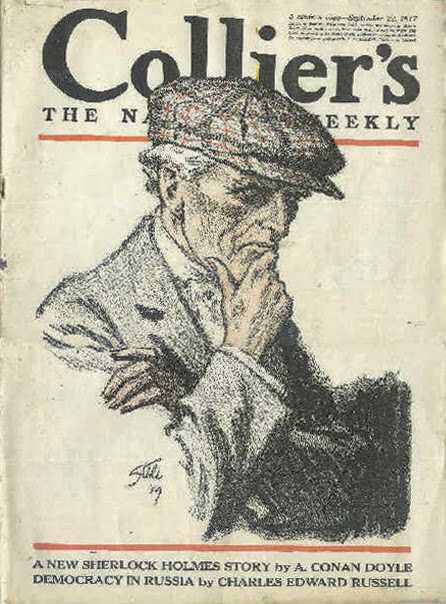
"His Last Bow" chronicles a fiction set in what Doyle's readers knew all too well by September 1917 had, in real life, proved "the most terrible August in the history of the world". As they read it, they knew not when the struggle would end or who would win. After three years, war and only war was the single all-consuming reality.

Doyle reflects and respects this by muting the comfortable and familiar until the final intimate, lyrical exchange where fictional words spoken in 1914 are charged with the actual sober defiance of '17. 

That real future is effectively intertwined with four years of fiction within the story's August 1914 hour of action and these resonances render the defeat of Von Bork symbolically momentous.
Von Bork, captive.  Illus A Gilbert, The Strand 1917.

So, as we follow the sequence of fictional episodes, present and past, it is within the known context of real and apocalyptic events. And the author's motive is as simple as his story - reassurance, in pursuit of which every element is designed to illustrate the complacency of the enemy and the superior ingenuity of John Bull. 

That pattern is there in the construction of what occurs within an hour from 9 pm on August 2nd 1914.

 The first half hour belongs to Von Bork and Von Herling. Doyle gives them their (premature) self-congratulatory taste of victory. "The good Altamont" is understood (before his arrival) to be admired and trusted implicitly. The reader is at this stage no wiser than the Germans and (with a Sherlockian delight in the dramatic), the author delays Holmes's coup de theatre to allow the detective private amusement in Altamont's  baiting of Von Bork about his exposed agents.

To the victors however goes the second half hour, crowned with a nostalgic tableau of the way things were.
Bruce & Rathbone "Sherlock Holmes and the Voice of Terror" (Universal) 1942.

From the conversations in both phases of the story's present the reader is guided to a similar understanding of the past. 

Initially, we believe, with Von Bork, that he has inveigled himself into English society since 1910 without suspicion and amassed a treasure trove of secrets that will soon be in Berlin. The work of four years is all but finished; he awaits only the latest set of naval signal codes to be delivered that night by his most resourceful spy. He has already sent his wife and large household to Flushing in Holland, leaving only himself and one servant, old Martha, who "might almost (harmlessly) personify Britannia". 

Doyle proceeds comprehensively to undercut every apparent enemy achievement. If the betrayal and capture of Steiner surprises Von Bork, it pales to insignificance once all is revealed. The ironies cut as deep into the German as they will delight his enemies.

Sailing under the false colours of "a good old sport" is exposed both as a paper-thin disguise and no true reflection of the blackguard within as Doyle presents the newly revealed Holmes with all the courtesies of a real sportsman and gentleman.

Did he but know it, Von Bork was a dead duck in the water from the moment Altamont surfaced in 1912. Undetected as submarines, Holmes and his female confederate disguised as old Martha penetrate organization and household. Networks of communication and agents are fatally, secretly compromised. No wonder then at the German master spy's incandescent curse.
Von Bork humiliated. Illus A Gilbert, The Strand 1917.
 "Curse you, you double traitor!' cried the German, straining against his bonds and glaring murder from his furious eyes."

As Sherlock Holmes notes, following this "furious stream of German invective", the German's unmusical outburst is an "old sweet song" often heard in days gone by. It's a swansong: Von Bork has taken His Last Bow.

Epilogue. 

And so had "Altamont". So too, did Conan Doyle intend the collection's eponymous title to signal the last of the stories.

In this centenary year we are perhaps best placed to be thankful the only last bow in real life was that of the Kaiser. Cameth the hour, cameth the men.

This one.
 This one.


And Millions Like Us.

© Ray Wilcockson (2014) All rights Reserved

Further Reading: 

"His Last Bow" by Sir Arthur Conan Doyle may be read on line HERE .

My short story "Good Night, Mr. Sherlock Holmes" imagines the events of the day after "His Last Bow" and may be read HERE .


Thursday, July 17, 2014

Form, Intent, Content and Language - The Barrowford Letter.

Some brief comments, supplementary to this post by GoverNancy writing on TES Connect about Barrowford Primary School's letter to pupils. GoverNancy reproduces the letter.

What follows records my response when I read the letter via Twitter prior to the appearance of online commentary. It's the approach I take to all written matter.

What am I reading?

Form is an authorial choice, a signpost to how I am invited to read and with what evaluative criteria.
This is in letter form. I am not addressed. A headteacher is addressing an 11 year old. However, it is standardized to include all relevant recipients and hence in the general class, formal letter, enclosing, as it does, that most formal of communications: exam (here SATS) results. I would in normal circumstances never have read this letter. A parent published it and it has subsequently been widely read, by far more people than those to whom it is specifically written.

Why was this letter written?

Authorial intent is patently to write something as an introductory courtesy which may accompany and offer context for educational information of the highest significance to writer and reader. The alternative was to forward the results alone. I reflect that the letter did not have to be written, that the writer has much else to do, that it is close to year's end, that the students addressed are leaving and hence, the writer will rightly, humanly feel all that implies.

I find myself describing an altruistic impulse which I am not surprised to find in a teacher.

What does the letter say?

I note that the central communication, eagerly and anxiously awaited by pupil and parent or guardian, is the all-important exam result. Given that unmistakable presence, I hardly expect the letter to state the obvious. It would render it superfluous. The introductory paragraph is enough to confirm what all involved are acutely aware of: SATS results matter a lot.

The bulk of the letter is expressly designed to affirm this is a school that values and (here) celebrates much much more than that which SATS results report on. This affirmation is not merely a personal (and certainly neither a prejudiced nor political) passage - the head teacher is echoing the National Curriculum for KS1 and KS2, as is her legal duty.Specifically, she takes this supremely appropriate moment to remind all concerned that the school curriculum comprises more than learning. Section 2 HERE formally expresses that which the letter details in a language more appropriate to a different context and audience.

I make a mental note that the final paragraph (of course) returns to the matter of SATS and that "there are many ways to be smart" has no pretension to be an educational theory. She's right - children are praised for a "smart" appearance and SATS doesn't report on your prowess with the violin.

Is the language appropriate?

"Smart" is a word in common (as opposed to academic) use, closer to "smartypants" than anything else. It suits the audience and broader education theme. Clearly, this teacher is going for language that's informal and accessible to children (parents will read and, from the flurry of positive public responses, pick up on this head's intended implication - we understand your child and they understand us, see?).

I recognized immediately that I'd read the central paragraph via a link months before. Notions of plagiarism are just not relevant in this context. I thought of the head, finding a moment to try to support her pupils at a crucial time the best way she could muster. Well, this passage, in content, language and spirit does the job.

End of.


Monday, June 9, 2014

Conan Doyle - Our Man in the Moon.

Mark Gatiss as Cavor in his version of "The First Men in the Moon" 2010 BBC4.

"There is nothing new under the sun. It has all been done before." ~~ A Study in Scarlet

Even for Mark Gatiss, it would perhaps have been an allusion too far for his character Professor Cavor to have made out the scratched initials "ACD" on the side of a lunar crater in BBC4's adaptation of "The First Men in the Moon". Doyle had, however (as with the Sherlock Holmes Gatiss was also adapting in 2010), 'been there' before him.

As the 19th became the 20th century, the orbits of Conan Doyle and the Moon twice came within similar close proximity.

The more recent dates precisely to August, 1901. Since the previous December, Strand Magazine had been publishing H G Wells' forthcoming novel, "The First Men in the Moon" in monthly parts. There had been no new Sherlock Holmes stories since FINA of December, 1893. That August number contained both the final part of the Wells and the first chapters of "The Hound of the Baskervilles".

Earlier, on 12 June, 1899, William Gillette's "Sherlock Holmes" was given its copyright performance at the Duke of York's Theatre, London. (see HERE ). While Charles Brookfield and John Webb preceded him in England, Gillette is generally viewed as America's first Sherlock Holmes (and the world's first serious portrayal).

US Sherlockian, Howard Ostrom, has, however, recently added to his well-known internet gallery, The Ostrom Collection , the photo and autograph of an actor with greater claim to be the first American Holmes - Ferris Hartman. 

"The Man in the Moon" (just like 1893's "The Clock" by Brookfield & Hicks a musical revue), premiered at the New York Theatre on April 24, 1899 and ran for 192 performances (see IBDB Entry ). The large cast included Hartman as "Sherlock Holmes", the 30 year old, Marie Dressler and (heading the cast as the greatest male box office draw) Sam Bernard as "Conan Doyle".
Addison's "The Man in the Moon" 1892.


Ironically ("it has all been done before"), this American production was preceded in England (in 1892) by J Addison's "The Man in the Moon" which played at The Britannia Theatre (see HERE ). It should not be confused with its US namesake.

My focus here is on the representation of Conan Doyle, but Marilyn Slater has HERE a fascinating biographical piece on Hartman. It's also well worth reading Matthew Kennedy HERE for some detail of the content of the musical, Dressler's amazing lifestyle and a sense of the status of Sam Bernard.

Born Samuel Barnet, Birmingham, England in 1863, Bernard was, by 1899, clearly enormously popular on both sides of the Atlantic. The pairing of him with Dressler was a management coup. It's near poetic that in 1927 he should pass away on board ship in mid-Atlantic. The Montreal Gazette carried a report and obituary (see HERE ).
Sam Bernard 1909.


As yet, I have found no image of him in the character of Doyle but this 1909 photograph (as Schultz in "The Girl and the Wizard") gives some sense of the man at this period.

History for Sale illustrates Sam Bernard's signature in 1912/13 HERE and I'll close this brief visit to the Moon with what proved to be one of the last photographs taken of the first American to play Conan Doyle on stage, along with the inscription on the reverse.


Further reading:
Conan Doyle has a growing list of appearances as a character. IMDb has a useful collection of references HERE .

The history of New York Theatre (originally Loew's) is described HERE .

Vaudeville old and new has a biography of Sam Bernard HERE


    © Ray Wilcockson (2014) All rights Reserved

Sunday, June 1, 2014

"An Important-looking Door" - GCSE English Literature.

Richard Jutras as Owl Eyes in "The Great Gatsby" (A & E and Granada 2000)

“An Important-looking Door.” - GCSE English Literature.


“On a chance we tried an important-looking door, and walked into a high Gothic library, panelled with carved English oak, and probably transported complete from some ruin overseas.
A stout, middle-aged man, with enormous owl-eyed spectacles, was sitting somewhat drunk on the edge of a great table, staring with unsteady concentration at the shelves of books. As we entered he wheeled excitedly around and examined Jordan from head to foot.
“What do you think?” he demanded impetuously.
“About what?” He waved his hand toward the book-shelves.
“About that. As a matter of fact you needn’t bother to ascertain. I ascertained. They’re real.”
“The books?”
He nodded.
“Absolutely real — have pages and everything. I thought they’d be a nice durable cardboard. Matter of fact, they’re absolutely real. Pages and — Here! Lemme show you.”
Taking our scepticism for granted, he rushed to the bookcases and returned with Volume One of the “Stoddard Lectures.”
“See!” he cried triumphantly. “It’s a bona-fide piece of printed matter. It fooled me. This fella’s a regular Belasco. It’s a triumph. What thoroughness! What realism! Knew when to stop, too — didn’t cut the pages. But what do you want? What do you expect?”
He snatched the book from me and replaced it hastily on its shelf, muttering that if one brick was removed the whole library was liable to collapse.”

- F. Scott Fitzgerald, Chapter 3, “The Great Gatsby”


I thought of Jay Gatsby’s library in this week’s ‘unsteady concentration’ of news and views about GCSE English Literature, of that library and what it all seemed to mean. At least to me.

Library Open.

The current controversy is about books studied for external examination. In three decades of teaching to GCSE and A level I have never objected to a set text on literary grounds. I don’t now. Heads of English especially will appreciate the numerous exigencies that determine who teaches what; I won’t rehearse them here, except to recall personal favourites play little part in the process. I’d teach any text set or ratified by a board, as often or infrequently as required. Boards don’t select books they can’t assess. Either at GCSE or A level the texts set allowed me to educate students in the critical appreciation of imaginative literature.

Hence, one major thread of discussion this past week has been irrelevant. I refer to exchanges of opinion regarding the literary worth of (in particular) John Steinbeck’s “Of Mice and Men”. On the farthest limb of insupportable irrelevance sat the Tweet exhorting the generality to “Stop pretending...that “To Kill a Mockingbird” is canonical literature. It’s Oprah Book Club level.” This, in apparent ignorance of the presence on Oprah’s latest 2014 recommendations list of Tolstoy’s “Anna Karenina” and two Charles Dickens novels.
A related thread opined that the novella and Harper Lee’s novel have been “done to death” (in the words of one Tweeter). A variation on this theme has been to promote the notion that “stale” teaching is a consequence.
Now, I have probably taught “Hamlet” (having studied the play at A level and university) for two-thirds of my career. In my last college, I was, for several years, teaching “Hamlet”, “King Lear” and “Frankenstein” to both A2 and both A1 groups simultaneously, at variant places in the text and course. Every time was like the first - it was to the students and I made it so for me. Back in the ‘70’s when, as now, texts were slow to change (for practical, legitimate reasons), I decided never to keep last year’s course notes, never to attempt to reproduce historical responses. For me “Hamlet” is evergreen.

Equally, especially as Head of English, I felt it a responsibility to teach new arrivals on the syllabus. It didn’t matter what they were. At root, it’s simplicity itself to avoid repeating texts. If the teacher/department want to, they can. If the exam board is concerned about a text, it can replace it. If those who consider the American writers above to have been “done to death” one wonders why they fail to find similar fault with “An Inspector Calls” or, more prominently (it’s Hobson’s choice), the narrow range of Shakespeare’s plays typically on offer - probably narrower given the universal omnipresence of “Macbeth” and “Romeo and Juliet”. These have been ‘done to death’ - but only in the drama.

Content as I am with each book in the ‘libraries’ specified by the four GCSE exam boards, I have concerns about the librarians and for the readers.


Librarians and Readers.
In 2010, the traditional selectors of texts, the exam boards, were still actively responsible. This Independent article clarifies  by whom and how books were chosen. Since late 2013 (when This specification was published) all boards have been subject to a new hierarchy which delimits their traditional role. The lineage of that imposed structure reaches up through the DfE and Ofqual to the Education Secretary and, ultimately, the National Curriculum. Powers that, hitherto, have been brought to bear on education to KS3 and on the conditions of teachers are now (logically) focussing on our relatively infant exam boards, throwing them just as surely into reactive mode. These new draft specifications for English Literature are first reactions - and would not be in contemplation without the new DfE requirements, which are uniformly binding.

While I firmly oppose the National Curriculum, this is not the place to argue its merits. There are, by now, after all, too many who have never known anything else. I think, however, we can all agree the intention is to offer every student the best we can and that state power is a formidable thing which, when exercised, had better be beneficial. So, let’s assess the effect the state ‘librarians’ are having on our short ‘chain’.

The Chief Librarians.

There is, of course, a superfluous magnanimity in Michael Gove’s assurance he is banning no books and pupils, with or without teachers, are free (indeed encouraged) to read whatever they wish. We do not need to be granted a freehold already enjoyed. The issue is not freedom to read: it is what we are free to read for detailed study to be examined on at GCSE. To continue my library analogy, we are precisely concerned with the (hopefully extensive) larger “stacks” or pool from which examiners may from time to time select set texts.

That pool is described by the DfE in the following crucial passages of its 2013 document, the only quotation I need present here:
"Students should study a range of high quality, intellectually challenging, and substantial whole texts in detail. These must include:
-at least one play by Shakespeare
-at least one 19th century novel
-a selection of poetry since 1789, including representative Romantic poetry
=fiction or drama from the British Isles from 1914 onwards"
The opening sentence is general and embraces all literature written in English that satisfies the description. The second sentence enforces the inclusion of the range then detailed. In retrospect, perhaps, the authors regret (they should) placing so much responsibility on one word in the interpretation of intended meaning. It matters whether you take “include” to mean “wholly comprise” or “ensure present as part of the general range required”.
Another matter the DfE would be wise to revisit is the validity (not to mention imprecision) of the phrase “from the British Isles”. It’s a self-defeating inconsistency and an insupportable restriction. The specification elsewhere calls for breadth and depth of high quality literature but this phrase ironically jettisons everything written in English overseas in precisely a period of especially fertile flowering.  Contrast the 19th Century novel. I can think of no valid reason to limit the later period but not the earlier.
I’d expect both the DfE and Ofqual to query certain features common to all of the exam boards’  specifications if they prove not to be addressed in revised drafts.   
The Chain Librarians.
OCR, AQA, Eduqas and Edexcel published remarkably similar drafts this week. Most notably, not one offers any addition to the range signified by the four DfE requirements. Having accepted this range, all other stipulations automatically apply. No other reading will share the status of those texts to be examined for grading. Schools vary in the matter of wider reading at GCSE. The crucial point is that only the set texts will enjoy detailed study. This feature makes them special to all affected.
Boards offer variant numbers of choices (one wonders just why) but evince a striking unanimity in core selections across the board. So uniform is their common approach that I’d simply register with the one I’d worked with before, which has its bureaucratic advantages.
No board takes up the single opportunity to offer a novel written in English by a non-Briton - the 19th Century requirement would, for example, be unimpeachably met by the inclusion of one of the best novels I know that illustrates the consummate ability of a writer to limit the broadest of personal vocabularies in the appropriate creation of an illiterate narrator: “Huckleberry Finn”.
Whence does this lost opportunity derive? Four ‘librarians’ in my chain made the same decision to restrict the 19th Century novel ‘shelf’ to Britons. Why? This is the first draft of a very different GCSE and at the very least this omission sends out a signal that non-British 19th Century novels in English are off the radar, possibly as permanently as the post-1914 prose and drama of America and elsewhere.
Is this really the intention enshrined in the DfE document? Have the boards collectively misunderstood, wilfully introduced restrictions, or frozen their reason in play-safe mode? Has the penny fully dropped anywhere in the hierarchy of librarians that they have contrived to disenfranchise great swathes of literature in English, reduce the total pool of potential texts for detailed study, implying the irrelevance of decades in which the world came to appreciate English literature was most fruitfully defined as  literature in English? Surely, as M would say: “This will not stand”?
With power comes responsibility. If this week’s statements from Michael Gove and the DfE represent the state’s intentions then the exam boards have not yet reflected them. Those who exercise power to instigate changes in the content of examinations may refer critics to the subordinate boards but this relieves not an ounce of responsibility for this (thus far) unedifying, divisive enterprise.
No doubt, syllabuses will develop with time and experience. For the moment, to ensure GCSE English Literature heads in the only legitimate direction is simplicity itself. I should feel more sanguine if reference to the British Isles is promptly removed and (as a token of intent) all boards extend text choices of 19th Century novels and post-1914 prose & drama to include works written in English beyond these shores.
The Readers.
How (as a librarian or reader) you perceive what constitutes literature in English influences the nature of response to poetry, plays and imaginative prose.
Literature in English is a democracy. I may be a Shakespeare specialist but I am wired against the notion of canons which seek to classify by comparative worth, authorial nationality or gender works of art that only exist when experienced in the mind of a receptive, observant, unprejudiced and thoughtful reader who is so sensitised to language that imagination is engaged. People are not normally called upon to justify their existence or prepare strangers with a bite-size “Guide to Me”. Artists, musicians and writers have fashioned what they ‘mean’ in the finished work and (rightly) balk at superfluous ‘explanation’.
I want to take the blog reader back to Gatsby’s library to illustrate why I view the current approach to set texts as a recipe for shallowness not depth concocted by the very people who should and I’m sure do know better.  The books are found indeed to be “real” - only in so far as they contain physical pages. That they are patently unread is evidenced in their uncut virginity. The man with the owl-eyed spectacles concludes this illustrates the fullest extent of Gatsby’s purpose in assembling a library. No book, of course, of any kind may exert any discernible influence on life unless someone cuts the pages and reads. The point is that we have here (in the emphasis on display and, for many, symbolic personal mystery in Gatsby’s motivation) just one example of the multiplicity of common obstacles in the way of direct experience of a book’s potentially real “reality”.
English teachers are all too familiar with these obstacles, usually erected by students themselves. A film or particular stage performance may precondition or usurp the centrality of  reading experience. Biographical, historical and cultural backgrounds may dominate the foreground. Bewitching incidentals such as an undue attention to authorial nationality and gender effectively delay ‘the cutting’ of any ‘pages’ let alone those of authors summarily dismissed as ineligible. The very library shrinks, cowers. Those tomes surviving the nationality cut do not celebrate; they brood, ashamed. They do not expect a fair hearing.
These obstacles relate to one of the central problems I’ve encountered over the years in the way students approach set texts. I call it:
The Tyranny of Theme.
Strictly, I mean more than theme but the word suffices to extrapolate to other manifestations of this phenomenon, notably in the treatment of character, imagery and natural description by literature students.
The sooner a student appreciates the difference between imaginative literature and its close sisters, history and biography, the better. Put simply. literature creates what never existed in ordinary life while history and biography seek to recreate and record. There are fascinating hybrids. I  once troubled to check all the libraries from Birmingham to Dudley to see how librarians had classified Laurie Lee’s “Cider with Rosie”. ‘Fiction’ or the Dewey 800’s or ‘Biography’ were equally represented. I also found it in folk tales (of the Cotswolds), agriculture, gardening, crime and on the history shelves. Lee’s raw material may be his own childhood but it is consciously imparted through novelistic means. It is as metal re-forged. This in itself seems to me depict how the adult Lee feels in recalling distant days.
The tyranny of theme feeds on an approach to literature borrowed from the reading of history and biography. Information and themes are mined, extracted and noted that are only meaningful, only breathe, in the context of the world in which they were created. GCSE bitesize revision notes (of ancillary value) service this perceived need. I have noted in a previous post the (entirely understandable) anxiety of A level students to collect from teachers and elsewhere handy prepacked ideas they can use in exam answers. Even the definition and recognition of literary terms often places cart before horse, insulating the reader from fulsome experience of imagery in the raw.. Characters, relationships and themes are neatly tabulated as akin to ‘facts’ while natural description is all too often undervalued (and skimmed) as ‘decorative relief’ or ‘setting’.
Closing Time.
Teachers of English literature thrive on depth and breadth in the study of poems, plays and prose and they’ll willingly cut the pages year after year in an ever-expanding library. They deserve an external exam system that draws its water from pure springs - whatever the source. If Asda, Tesco, Sainsbury’s and Morrisons reduced their range of flavoured bottled waters in unison to ‘Raspberry’ alone,  there’d be trouble at t’super market.
I simply hope for a system that unequivocally acknowledges the centrality of direct imaginative experience operated by people who demonstrate they have not forgotten the life-long insight and delight derived from realising  why, in the second chapter of “Sons and Lovers”, following the kicking of WIlliam, D H Lawrence chooses to take Mrs Morel “out over the sheep-bridge and across a corner of the meadow to the cricket ground”, there to sit, statuesque as Leontes’ Hermione, as the narrative moves to sustain over several prolonged paragraphs a heart-breaking empathic chorus of  natural description.
I want to sense examiners consider the nationality and culture of (say) Henry James of negligible interest in comparison with a transparent encouragement of students to wonder why William Golding’s “Lord of the Flies” island is so aptly peopled entirely with males. Especially do I hope for a focus that supports a GCSE candidate's emergent sense of form, that values the novella or short story for what they are - the most appropriate vehicle for the author’s imaginings, rather than stalled novels. “The Great Gatsby” was longer in first draft - the final “cut” is a gem. It’s on my shelf, filed alphabetically, smiling out between Fielding and Forster. All its pages were cut long ago. I like my libraries fully open, vast and real.

© Ray Wilcockson (2014) All rights Reserved.