Sunday, May 4, 2014

"No Staffroom for Old Men" - A View from Over the Bridge.


When we retire, we cry, that we are come to this great staffroom in the sky.

Saturday 3 May, 2014.

It's years since I attended a gathering of teachers but today's ResearchEd in York was streamed live and I took the opportunity to listen to some fellow Tweeters. The day proved to be about far more than its title suggested and I'll examine why in due course. First, it seems useful to take the reader back in time to...

An 80's Staffroom.

I was already retired when the Gove Glacier scoured its relentless way down the valleys of education and, for one who loved and misses the classroom, it is bitter-sweet compensation that I'd neither want nor feel able to teach under the current dispensation. It's no country for this old man.

By 1988 I'd moved into 16-19 teaching, so never taught to the National Curriculum. Even so, the college staff experienced winds of change with regard to the treatment of staff, small in themselves but indicative of things to come.

First, something novel began appearing in pigeon holes - the memo. A new senior appointment with an office just down the corridor chose to write (typed!) what was easier to say in person. I watched colleagues bin missives in astonished distaste. The penny - eventually - dropped that this was a college where teachers talked to one another.

One glorious summer 3 days of INSET at the end of term took the whole staff to a venue owned by freemasons. Lodges don't have windows. A sweating, seething staff is not a pretty sight. Nor was the bill for rooms, refreshments and (uninspiring) speakers. That April had seen capitation cuts; ring-fencing for such INSET extravagance was savaged in full staff meeting and College Board. In future we ran our own, bespoked to our own agenda, for free, in college.

Successfully too, we fought what I see now as a rear-guard action in defence of regular full staff meetings. Noting a decrease in frequency and a tendency for senior management to select and monopolise items that talked at a passive audience, we reclaimed both regularity and agenda.

When I left that college for (Welsh) pastures new, someone paid me one of my most cherished compliments. A young Chemistry teacher in his first year asked for a private word after the 'Goodbye' do. We had never had reason to speak before, he said, but he just wanted me to know things I'd said in full staff meetings had given him strength, faith and inspiration to stay in teaching. I'd given expression to matters he realised he valued. He was not to know this was precisely what had happened to me long before in 1969.

A 70's Staffroom.

My first colleagues (for 5 years) inhabited the staffroom of a 3-form entry, 11-18, selective technical school. I returned to the school after secondment for a similar period, when, after the 1974 reorganization, it had re-opened as a 6-form (sometimes 8) 11-16 comprehensive. Despite their differing sizes, each staffroom operated as engine room, mess and recreation decks in every teacher's daily life. 'Embrace the mess" says the mantra. We did. And cleared it once (Augean-style) at term's end. This was the epicentre to which all gravitated. Departmental staffrooms and individual work stations neither existed nor were desired. You might mark in quiet for half an hour in an empty classroom, but you'd return to where the action was, quite naturally.

Here were the all-important notice boards (pigeon holes were mostly for post): sports teams, union notices, calendar...and, crucially, the only copy of the whole timetable next to 'cover for the day'. This last you checked frequently: we did a lot of cover, often at short notice, in those days. To be based in the staffroom, there to do my marking, grab a bite and field issues as they arose was just as essential when I later headed the English department and its parent area. Practical.

But this environment offered so much more than mere efficiency. It sustained a natural continuum of direct human association. If for a moment I think of a school as a living organism, that first 11-18 was the healthiest I've known. The presence of a sixth form seemed to me doubly beneficial: younger students are daily in the presence of those who people the spectrum between themselves and professional adults. For the teacher, I hold that the frequent shift from an A level class to one of (say) 11 year olds enhances the clarity, depth and sensitivity brought to both age groups. One lives and absorbs the range. However, this is not, for the teacher, enough.

The beauty of such a staffroom as I describe is the essential, extra dimension afforded for adults to be, as naturally and as often, with other adults. And these are not just any adults. They are the teachers who currently, or did, or will teach the pupils in your classes. To rub shoulders with these people is to experience something of the daily, yearly and whole-school experiences as each pupil perceives them. Your own staff are a teacher's second best resource (after yourself) because their knowledge of these children is localised, specific, current and professionally filtered.

Almost all I know about teaching was derived from personal observation, trial and error and a process of natural absorption of my colleagues' insights and experience (which included their teacher training, as I had none). Staff meetings were riveting. They were my chance to listen to wiser heads speaking their minds without fear or favour and to consider (silent at first) just where I stood on the issues of the day, arising, with agenda priority, from the staff.. This was INSET at its most dynamic and meaningful and (with the honourable exception of a course on Listening) I have only ever really valued full staff meetings and such home-grown initiatives as that of our remedial department in this school's comprehensive incarnation.

The purpose was simple: give all staff first hand experience of what it felt like to be totally out of your depth in a lesson. Along with other heads of department I taught half a day of the most difficult concepts I could think of in English (Eliot's theory of the objective correlative, Metaphysical poetry and the like) to 30 non-English staff and spent the other half as 'student'. Raw, chastening experience. Lesson noted. But, oh! How we loved watching our talented colleagues in their chosen calling.

In Praise of the Informal.

 A visitor to the staffroom I describe would not. I hope,  have been fooled by its characteristic  informality and apparent chaos. Mankind may not be able to bear much reality (and teachers certainly need a break from their pupils...and vice-versa) but people thrive on variety and relish hard work that is engrossing, owned, valued and leaves wriggle-room for human warmth. Thus, just this week, I watched a programme featuring two water workers doing the worst job in the world (clearing sewers) with good spirit and a camaraderie that made light of it all, rounded off with a pizza binge. What people cannot bear, for long, is a bland diet of unrelieved formality.

The formal register has its place. But, in the staffrooms of my earlier career, many an issue was put into perspective and settled without undue formality. This effectively fielded and aired concerns about pupils that were not so serious as to warrant formal notification, concerns that may never see the light of day or suffer exaggeration where the absence of a working staffroom necessitates arranging a special meeting in someone's office.

The working, united staffroom can seem a fearful place for senior management - the less they experience it, the more distantly formal they grow. (You see where I am going).

It need not be so. In that first school, there was some concern that our Head, returning from extended sick leave, might not be quite ready. One busy morning break, he popped his head round the staffroom door and summoned me, by name, loudly, from the far end of the room.

"Mr Wilcockson! Come here, if you will!"

The tone was serious. Jaws dropped. Elbows nudged. He watched, they stared, ominous as les tricoteuses at the guillotine, while I traversed the crowded room.

"Your shirt's hanging out." A cherubic, mischievous laugh and he was gone.

With one superbly timed moment of disarming humour he had allayed all fears, shown he was at ease with the staff at large and (a personal bonus) transparently happy with my work, having no formal issue to raise. Quite how he would have achieved this instant restoration in a school without such a staffroom defeats me.

Comrades and Colleagues.

One Autumn evening, that same head could be found, happy as Larry, standing on the slack in my coal house supping a pint in deep educational discussion with a motley assortment of senior and junior colleagues. It was the 'after play party'. The house being full, they'd taken to the back yard.

I think on reflection now that it was because the staff of that school (as selective and comprehensive) lived cheek by jowl, knew each other so well, met in a united staffroom and owned their gatherings, that they naturally, readily participated in school life outside the academic day. It is utterly appropriate in a profession that is a humanity (and not a business) that its practitioners have the freedom to exemplify in their own lives that absorption in cooperative experiences (in classrooms and everywhere else) which makes for happy living and learning.

Just as students are much much more than their grades, so teachers are not to be defined by their labels. When I sat down with Brian to write large-cast plays for our school drama society, he wasn't Head of Maths. When pupils rehearsed alongside teachers and parents and then performed "The Crucible", something else had melted away - temporarily irrelevant formal distinctions of age, of status, of skill. You cannot "teach" these things, still less formally "require" them - they have to be experienced and are only born from a body of teachers who are free to be comrades as well as colleagues.

In short we had energy to play with because, individually and collectively we enjoyed and took seriously the autonomy of professional trust. Work-life balance isn't an issue for those who possess work-life integration. The skies were emptier then.

Truth to tell research played little part in our lives. New ideas, supplementing initial training, tended to come with new appointments or were introduced (with the lightest of touches) by LEA advisers. If they gained currency, it was through gradual testing, modification and absorption not prescription. Sometimes I wish the internet had existed, for access to new thinking is so much easier nowadays. On the whole though I believe we were doing other things which felt wholesome and worthy, things ideas alone can never achieve.

The Research Movement.

I choose this wording as a catch-all for more than the event at York represents. Since 1988 educational research has received unprecedented attention because recourse was made to (some of) its findings to underpin governmental and business re-modelling of education.

The first thing that strikes me about such teacher-owned initiatives as ResearchEd is that it is a response in kind to the above, born of the dawning realization that not all research is good and some is downright dangerous. Under Gove especially we witness a side-lining of both LEA & College of Education expertise, in favour of centralised dogma. ResearchEd engages the government on its chosen ground as well as (admirably) providing teachers with resources and a forum for patently enthusiastic, critical thinking about their practice.

I do not think this is going to be enough; nor do I observe this to be the only significance of ResearchEd, which has much to say also about the importance of re-validating and re-empowering the Teacher's Voice.

The teacher of today is in the ironic position of having instant access to a world-wide, virtual staff, but far less everyday association with the real one in his or her own school than I was afforded.

I read of new schools built without staffrooms, of existing ones converted to classrooms, teachers isolated in subject base and office or in the constant company of pupils in and out of lessons on the justification that every moment is deemed formal work. I maintain that your own company is not enough; that association restricted to your own subject staff effectively blinkers a broader, richer, participatory relationship with your school; that unremitting proximity to children and 24-hour exposure to anyone (SLT, student, parent) who thinks it's OK to send you a faceless memo by e-mail) are thoughtless, inhuman and debilitating. Whether by insensitivity or design such arrangements effectively dismember the body of the staff and silence its common voice.

A student teacher I know has been a term at a local school. There are two "briefings" a week (before school). He's never heard the Voice of the Staff. What sort of society is that?

I can think of no better word than "joy" to describe the exhilaration sensed in those tweeting and blogging gleefully from York (and, for that matter, staying up late at night to blog themselves to sanity and simply connect). Enthusiasm for new ideas, but JOY for the unclouded skies of camaraderie. And I would ask this question: if this level of elation is rarely if ever felt back "home" with your own comrades in arms, why not?

A specific idea seems to have emerged from this weekend's 'staff meeting' in York - that it would be great to have someone in each school with research responsibility. Such a green shoot will flower in fertile ground. At the moment (as ResearchEd and Teachmeets illustrate) such suggestions come from and are valued by real and virtual extra-mural 'staffrooms'. How fertile is your own? My own sense, for what it is worth, is that on the only ground that really matters - the school you teach in - what's needed at root is the propagation of that joie de vivre that suffuses a staff and a school at ease in humanized systems.

In "The Phoenician Women" Euripedes writes: "This is slavery, not to speak one's thought." I hold, therefore, that the dissolution of traditional arenas for the shared ,confident and valued articulation of teachers' views within schools is an enslavement. There is no generosity in the specious charity of giving teachers "freedom" to choose how to teach while disenfranchising them in every other aspect of the profession. Critical thinking brooks no boundaries and to abuse the teacher's freedom of thought and expression is merely to teach children there are only certain matters about which you are "free" to speak.

No wonder teachers leave. Who would bear the whips and scorns of such a time and the oppressor's wrong for long? Well, teachers would, and do. Until body and spirit just give out.

This must not for long remain the way of the world.

The Great Staffroom.

No more marking. That's what you notice. First. When you arrive.

No bells, no dates. No cover to do or meeting to attend. In place of nights of preparation: sleep and memory.

There are many of us but it's quiet here, the room as vast as vast may be. We are all here. Together.

I came quite recently, having served the last three decades of Century 20 (aka The Blobocene Epoch). Former colleagues, I am aware, are here too. Not that we meet: you have to be doing things for that to be meaningful. We remember, each, what was done. That is enough. Anyway, all but one of my schools no longer exist. We are but legend.

On my daily walks no doubt I chance upon one of your own school teachers, exchange pleasantries with those who taught our country's politicians. They all care. It is rumoured Plato himself has been seen to pause a moment near the bridge on the way to the Gymnasium, deep-browed in furrowed thought.

The ghosts, too, are here. I feel them.

Such is the Choir of Caring - no teacher is ever alone.

It is Milk Wood here across the bridge.
Listen. Listen.

"Sudden in a shaft of sunlight
Even while the dust moves
There rises the hidden laughter
Of children in the foliage
Quick now, here, now, always." (T.S.Eliot "Burnt Norton")


 © Ray Wilcockson (2014) All rights Reserved.

Tuesday, April 8, 2014

The Promotion of Friend Lestrade.


Inspector Lestrade (Colin Jeavons) in Granada's 'The Six Napoleons'.

Friend Lestrade.

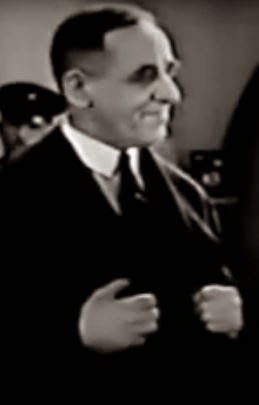
"The Six Napoleons" is one of my favourites in the Granada Holmes series not least because it is THE Lestrade episode. The hour begins and ends with a masterly triple act performed by Brett, Hardwicke and Jeavons and the still above represents a passage of consummate, largely silent comedy roughly halfway through the story. Finding himself alone in Baker Street, the Scotland Yarder (we just know!) half-imagines himself to be the Great Detective, trying, as it were, Holmes's armchair for size (and inspiration). Holmes and Watson join the eavesdropping audience as Lestrade gives way to temptation,  peeking (unprofitably) into a folder of private papers.

The exquisite, moving 'handshake' epilogue confirms the greatness of Colin Jeavons' performance, the promotion of Lestrade to most significant policeman in the Canon, to the status of "friend" and to an acting role coveted by the best of our actors. I think it a direct consequence of Granada's creation that Lestrade's torch burns so bright this century in the capable hands of Rupert Graves, Sean Pertwee, Eddie Marsan and Mikhail Boyarsky.

The Jeavons portrayal confirmed Lestrade as Chief amongst Doyle's Inspectors on film and faithfully reflected the character's association with Sherlock Holmes over two decades, despite adapting but five of the thirteen Canon stories in which he appears (and transferring him to CREE).

[Aide memoire: Jeavons appears in NORW (1985), EMPT, SECO & SIXN (1986), CREE (1991) and THE MASTER BLACKMAILER (MILV) (1992). Click HERE for a list of Canon appearances, noting that, before FINA in the Canon, Lestrade appears in STUD, BOSC, NOBL & CARD; before FINA ep 13 in the Granada series he is introduced and only features in NORW ep 10. ]

Excellence of acting, aside, (for me) Granada's appreciation of the nature of short story renders this portrayal of Lestrade unsurpassed. I know of no other production that understands so clearly what a short story is, how ideal it is in form for the Sherlock Holmes series (not serial) and how it may most fruitfully be adapted.

Reading the Clues.


"If any little problem comes your way I shall be happy, if I can, to give you a hint or two as to its solution.” Holmes to Lestrade SIXN.

Short stories are the sonnets of prose fiction. Just as the fourteen line poem is not an incomplete ode, ballad or epic, the minimalist painting is a finished work. It was Doyle's express intention when first writing for The Strand to create stand-alone detective stories. Order was immaterial. A story was one case and he hit upon the ideal narrator in Watson and the most flexible, potent format-  the reminiscence - through which to record "any little problem". The short story, not the novel, is the classic Sherlockian form.

Consider the elegant parallel of the problem presented,  the "hints or two" to a solution and the mode in which short stories work upon the reader. "The parallel is exact". There is about the construction of the short story the same severe discipline that Holmes brings to his arrangement and examination of "the facts" and an identical requirement (on detective and reader) to hypothesise, expand, deepen and flesh out. Doyle's art lies in his intuition for saying just enough and no more to feed the reader's imagination. He does it with scene-setting, descriptions of weather and, most relevantly here, with characters. It is also no accident that the Canon is eminently quotable - Holmes is given to aphorism which is harmonic with the chosen prose form and theme of detection.

The Granada team fully comprehended that a short story comes alive directly in the reader's imagination. A  play script on the other hand comes alive via performance by actors. In adapting fiction for stage or screen account must be taken of these crucially different modes of experience. Brett's performance is emblematic of how Granada's script writers found a filmic equivalent to the "hints" a reader would normally expand, deepen and flesh out alone. He is all gesture, expression, exclamation and posture designed to convey quanta of information far beyond the simplicity of the action. The "mind palace" of Benedict Cumberbatch's Sherlock is externalised in on-screen captions; Brett's technique of hinting (yet just as wholly communicating) is closer to the Tardis which is bigger inside than it seems from without and a closer parallel to Doyle's own method.

It is in this fertile context that Inspector Lestrade leaps so readily to life in the hands of a highly skilled actor and the scene with which I began this post is example of how, with the minimum of actual appearances in the series, the portrayal is yet so potently brought to the screen.

The Ladder of Promotion.

Frank Finlay as Lestrade in "A Study in Terror" 1965 Compton Films.

Other adaptations may not be as sensitive to the nature of the short story but have contributed significantly to the elevation of Inspector Lestrade to the status he now enjoys. Jeavons stood tall on the shoulders of others who had gone before. I rate, for example, Frank Finlay's performances in 1965 and 1979 and have a nostalgic soft spot for Archie Duncan, Lestrade and Little John of my childhood. However, I should now like to focus on the other significant moment in Lestrade's cinematic history when he earned a belated promotion after years of obscurity and made the part attractive to actors of Finlay's calibre and a source of daily bread for journeyman Duncan.

The Lean Years.

The first three decades of the 20th Century were barren years for Doyle's policemen. Of the four stage plays by ACD and/or William Gillette, only 1910's "The Speckled Band" requires a policeman - "Inspector Downing" - with the tiniest of roles. The silent era employed John Willard as 'Inspector Gregson' in Barrymore's 1922 film, the year after Arthur Bell's 'Inspector Lestrade' for Eille Norwood in the shorts: NOBL, RESI, EMPT & TIGER. In 1923, Tom Beaumont covered all three detective roles ('Lestrade', 'Gregory' & 'Taylor') in  Norwood's versions of MAZA, FINA, LADY, CARD & SILV.

The rest is silence - Friend Lestrade remains as obscure and distant as Joseph Alexander Lestrade of St Lucia. Generally understood to be the man who lent his name to Doyle's character, Joseph was an acquaintance in Edinburgh and took his degree (Bachelor of Med & Master of Surgery) in 1883, two years after Doyle graduated. It would seem he returned to his native island and I believe I find him there in 1904 as "Joseph Alexander Lestrade M.B.C., Q.M., Colonial Assistant Surgeon", residing in the original capital, Soufriere. There are unspecified charges against him in the National Archives for 1905 - no doubt he encountered a policeman.


Philip Hewland as Inspector Lestrade.
Charles Mortimer as Inspector Lestrade.
The (talking) thirties had, naturally, a growing pool of experienced film actors. While the performances are limited by that traditional focus on Holmes and his villain attributable to William Gillette's influential play, seasoned actors like Philip Hewland & Charles Mortimer ( for Wontner) and Alan Mowbray (for Owen) brought considerable stage and screen skills to what remained two-dimensional Inspectors.


 "Forever two long steps behind “Mr. ‘Olmes”

Yes. Dennis Hoey.

The first real step-change, the first secure move up the ladder of promotion may be observed in the six Universal Films made in 1943-6 starring Basil Rathbone and Nigel Bruce. Unsophisticated as the characterizations may be, both Doctor Watson and Inspector Lestrade would never be the same again. Bruce and Hoey were famous, illustrious and well-loved actors of stage and screen and (modestly, I feel) restored their fictional men to the status Doyle intended. "Lestrade's little cock-a-doodle of victory", you might say.

Friend Watson & Friend Lestrade.
Dennis Hoey, born during the Great Hiatus of 1893, is the first performer of this part whose name most people know. I shall not dwell on the Universal Films except to note Lestrade's banter and humour with, especially, Dr Watson illustrates hitherto untapped possibilities in this role.

What may not be as well known is that Hoey was extremely versatile (He played Rochester on stage and his appearance as White Chief, Mala, in 1937's "Uncivilised" may be viewed HERE ) . He was an excellent singer, creating the part of Ali Ben Ali in the first stage production of "The Desert Song". In a delightful coda to his film career Dennis Hoey got to play Sir Arthur Conan Doyle in the 1956 Omnibus television programme "The Fine Art of Murder" also starring Rex Stout as himself.

I shall end this lengthy post with two delights: a British Pathe short from 1930 of Dennis Hoey singing AND a moving, fascinating reminiscence of the man by his son, Michael. Do read it.

The film link: HERE

Michael link: HERE

N.B. The following link will take the reader to an excellent IMDb list of Lestrade Films: HERE

“Look at that with your magnifying glass, Mr. Holmes.”


© Ray Wilcockson (2014) All rights Reserved.


Wednesday, March 19, 2014

"A Detective Rare" - Angela Buckley's "The Real Sherlock Holmes" (Jerome Caminada).


"Has the real Sherlock Holmes been deduced?" wondered the headline to Jasper Copping's review in The Telegraph 15 March 2014 .

Angela Buckley's "The Real Sherlock Holmes - The Hidden Story of Jerome Caminada" is not the first to propose the Manchester detective as inspiration for Conan Doyle's fictional detective. Don Hale's (much slighter) November, 2013,  publication commits to the title  "JEROME CAMINADA - The Victorian Detective - The inspiration for Sherlock Holmes" (sic). Intrigued by the Copping piece I read the Buckley biography.

Attractively produced with 16 pages of contemporary illustrations, the book comprises four thematic strands: the author's family history, Sherlock Holmes, Manchester and Caminada himself. A Preface records the genesis of research conducted into the last two - the author's discovery that an ancestor lived on Caminada's first beat and was likely acquainted with him.

Such is often the way a family connection can inspire a broader interest in local history and it is a pity this thread is not developed beyond the Preface, which ends with a statement of the book's prime purpose:"I hope that, after decades of silence, the voice of this extraordinary Victorian super-sleuth will be heard once again". Well, it is and it isn't.

 I want to stress that I think the book well worth reading. It is enthusiastically researched (with a useful, extensive bibliography). Caminada and Manchester vie fascinatingly for the reader's attention. And they are strongly related, for, policeman that he was, the story and character of Caminada naturally highlight the condition of the poor during his career in Cottonopolis. Buckley indicates her book's strongest theme in an initial quotation from the detective, himself quoting Dickens:

"Cant as we may...we shall to the end of all things find it very much harder for the poor to be virtuous than it is for the rich, and the good that is in them shines the brighter for it."

 The book and its subject stand on their own two feet upon this powerful theme and it is a continuing irony that recourse is made to the fictional Sherlock Holmes only to mask "a detective rare" as a ballad described Caminada in 1893 (quoted in full on p114). I turn now to the Sherlockian content.

I have to conclude that the author and/or publisher felt the fictional detective would help to sell the real one. A title which employed the indefinite article before "Real" and a text which avoided anything beyond a casual reference to the character whose name fast became a byword for any good detective would not have shifted the spotlight off Caminada. Unfortunately, the title and references to Doyle's creation strain to draw parallels and befog the clarity of Buckley's portrait.

Copley and others propagate the notion that Doyle took inspiration from Caminada, that this is a unique selling point for this book. Whatever she may say outside its pages, Buckley makes nothing like a sustained attempt to connect the two men. The closest to a claim of this nature is expressed in the final paragraph: "His widely publicised cases could easily have provided inspiration for the stories of Sir Arthur Conan Doyle."

References to Sherlock Holmes in the text are patchy, too loosely related and, at times, inaccurate. That Doyle (but neither Holmes nor any cases) figures in the Index is in keeping with the superficial treatment of this heavily advertised aspect. 
My own suspicion that the author's interest and research were not with Holmes was aroused on p17 where "Star Blaze" survived proof-reading. Chapter 12, "The Beautiful Crook" thinks Irene Adler appeared in "novels" and proceeds to draw a parallel with the real-life Alicia Osmond that does not hold water. Similarly, the presentation of burglar, Bob Horridge, as Chapter 9's "The Professor Moriarty of the Slums" reveals a career criminal whose direct hands-on approach is the very opposite of Doyle's "spider in the centre of his web" who "only plans". All they in truth have in common is to have been the most formidable men encountered. 

"The Stockbroker's Clerk" and "A Case of Identity" provide initial quotations to two other chapters with little relevance and what is remarkable (to the Sherlockian) is the absence of apposite reference to the Canon where you may have expected it were this a serious attempt to relate the two detectives. Thus, the absorbing section in Chapter 5 on "Next-of-Kin" fraud is oblivious of, for example, "The Three Garridebs". 

On more than one occasion, the author argues against her own claim. Page 87 avows "Detective Camanada was not a 'first-class chemist' like Sherlock Holmes". By Chapter 19 he has become "The Garibaldi of Detectives" and Buckley quotes the Manchester Courier: "Mr Caminada was not exactly a Sherlock Holmes, but as a detective he did good service to Manchester."

The real detective is credited with powers of observation, disguise, deduction and wide knowledge of criminals as if this were so exceptional that he might readily have inspired Doyle. The book however illustrates little more than excellent local knowledge of beats he knew well and a logical use of disguise in streets where you were well known. Caminada's move in retirement to private detection was common and, while a parallel is drawn here with Holmes, the more obvious reference to Altamont in "His Last Bow" is not made when either the Fenians or Caminada's spying are discussed.

Most seriously, the author seems not to realise that the comparison of detective fiction and real-life detectives at the opening of Chapter 12 is in fact a strong argument NOT to haul Sherlock Holmes into this biography.

I have had occasion frequently this year to look at periodicals of the period. It is clear that from the moment Sherlock Holmes achieved popularity across the World, from the USA to Australia, his name became a byword (a shorthand) applied to detectives who solved a tricky case or was employed as a cry of desperation that "a Sherlock Holmes" was needed. I do not sense Angela Buckley knows this. Nor should she. Her absorbing work on Caminada and evocation of a Manchester thankfully long gone are good enough to stand alone.

When I re-read the story of Jerome Caminada (as I shall) it will be beneath my personal preferred title: "A Detective Rare".
  
© Ray Wilcockson (2014) All rights Reserved.


Thursday, February 20, 2014

A Scandal in Academia - On the Observation of Teachers.

"You see, but you do not observe". ( Sherlock Holmes to Doctor Watson "A Scandal in Bohemia". )

This post is occasioned by TEACHERS OR CRISPS? by @HeyMissSmith in which she takes issue with the  pervasive notion that the profession is in need of general improvement and that that is secured through inspectional critical and graded scrutiny by senior teachers and Ofsted. She argues that this is a counter-productive regime born of attitudes and motivations themselves the (real) object for improvement.

My career as a secondary teacher of English for more than three decades from 1969 bears this out in spades. There was (and therefore is) another way.

HMI Inspections.

Once per decade I was inspected by HMI as clear-sighted, empathic, respectful and autonomous as the teachers and institutions they visited. Lesson and whole-school assessments felt negotiated and balanced. These were positive experiences because the inspectors observed in the manner indicated by Holmes's remark to Watson.

Internal Inspections.

All my schools and colleges had a system of annual staff development assessments, which featured (centrally) self-assessment of perceived achievements and needs and classroom visits by the Head or a Deputy. I was never inspected by anyone else. Visits lasted the duration of each lesson and were conducted with patent respect, interest, participation and an open agenda: observe what is really encountered. Feedback discussion supplemented the final report with teacher evaluation of each lesson and an emphasis on the positives observed.

These feedback chats were always valued because most of the matters were dealt with as equal professionals discussing their common art. They could be of surprising practical use: for example, one Head was fascinated by the use of body language in the classroom and observed something I had never been aware of - that I had the slowest blink-rate he'd ever encountered in a teacher. He had discussed this with some students and all agreed that to sit in one of my lessons gave you the uncanny feeling I saw everything that happened...even that I saw what they were thinking. Not so; but I wasn't about to disabuse them!

Other Observations.

1. 1969-71.

I entered the profession in the last year you could with a degree but no teaching qualification. This, automatically, extended probationary status to two years. From Day 1, I taught a full 11-18 timetable. No one ever inspected me in the manner so familiar today. Observation, however, was frequent and took two main forms.

By invitation and request I observed many classes conducted by experienced colleagues. From these I learned all I came to know about classroom management and what I call presence. I offer one example: Desks were typically arranged in five rows of doubles with, therefore , aisles between. I found difficulty communicating effectively with the back rows until I watched my Head of Department (also a Ray) do two very simple things I'd never considered. He spent most of the lesson on his feet (away from the 'protection' of the teacher's desk) either conducting the lesson from the back of the room or (a very strong stance this) at the head of successive aisles, reaching all students under the 'umbrella' of one outstretched, emphatic arm-movement. This I imitated, just as effectively as I replicated the stentorian voice of Dick W... who could (as I still can) silence the whole school queuing for dinner. 

I was left in no doubt that what happened in my own classes was entirely my personal responsibility. This did not mean I was neglected. Classrooms are typically adjacent with thin walls. When discipline irretrievably broke down (and it frequently did) the present problem was dealt with either by the teacher next door or a deputy taking over the lesson for long enough to a) discipline the class and b) demonstrate the art of teaching. My desire to learn was taken for granted and I felt supported but never undermined. Simply, I sensed, that if I did not learn by example, then fight my own demons, I'd not cut it in the long run as a teacher. No one ever suggested visiting to observe because I knew they were doing this in far subtler ways.

For example, I did not fail to observe how frequently Heads of Year and Deputies glanced in through the door window or popped a head in 'for a word' with A or B. Stan M..., a Head of Year, never passed through my lessons in the school library (on his way to collect geology specimens) without adding humour, moral support, educational enrichment and professional comradeship to my work. The message was we were all in it together and we respected the subtle complexities we teachers call 'a lesson'. Teachers like Stan were (are) legion - they have Holmesian powers of observation that take in realities in a moment and act accordingly. I have been proud to  know Heads who have slipped noiselessly into a lesson and sat patiently until they sensed a convenient moment to pursue the (often minor) reason for their visit. 

2. As a Qualified Teacher.

It may raise a sardonic smile in many a 21st Century teacher as I record that a standard sentence on my annual self-assessment was to the effect that, as I considered all my teaching was done on behalf of the Head Teacher (saving him or her from having to teach all classes), my classes were there for the visiting any time the Head wished. An open invitation that, to their credit, I think all my heads and principals took up with enthusiasm. 

Otherwise, within my departments, I was fortunate to work with some colleagues who valued teaching a class together where there was a perceived gain for the students. In the teaching of English many occasions arise where the active contribution of a subject colleague adds freshness, variety and a different perspective. From Year 7 to A level, lessons may be aptly enriched with judicious recourse to the double-act. One example: a prepared full reading of T S Eliot's The Waste Land dramatized for two (teacher) voices and performed for combined A level classes, invited to listen with no text to follow. English teachers are necessarily fluent and highly effective readers and give of themselves in such memorable lessons. Student feedback often noted how much more meaning and impact may thus be rendered evident in a literary text. 

On other occasions, we might request a special appearance from a colleague to act a part in a play or bring their class to discuss a specific topic, such as exam preparation. Variety, professional comradeship, common goals, mutual caring. Everyone (pupils and teachers) learn.

A Final Observation.

 Teachers have ever completely understood their work may always be improved and is a proper subject for inspection. In 1969 as now these tenets underpin a profession that is a humanity and an art. My private analogy has always been with the artist and the apprentice. I would simply ask (with, I believe, Miss Smith): Which would you observe to learn more, artist or apprentice? How best does the apprentice improve: by micro-scrutinizing performance with an abstract checklist of someone's notion of simplistically measurable artistic skills or by encouraging the apprentice to observe the master and mistress as they create? AND, finally, who would have the insensitivity, the patronising stupidity to critique an artist in media res as something unique and self-valuing is being created?                  
      

My Previous Education Posts.

Let the Forest Judge. 4/2/14   HERE 

Of Decile Bands, Levels, Cabbages & Kings. 18/7/13 HERE

Two Allegories about Education. 10/7/13 HERE 

The Empty Space and the Illusion of the First Time in Teaching. 28/6/13 HERE

An Inspector Calls – My Thoughts on Three Teachers' Blogs. 17/6/13 HERE

Brush Up Your Shakespeare – Set Text 2013 for Department of Education Study. 12/6/13 HERE

The Day That the Rains Came Down – Halcyon Days (for Jenny). 8/6/13 HERE

Learning By Hearts – a Poem to Read, Learn & Inwardly Digest. 7/6/13 HERE

A Fable for Our Times. 3/6/13.  HERE


Tuesday, February 4, 2014

Let the Forest Judge.


    "You have said; but whether wisely or no, let the forest judge."
     
     (Touchstone - "As You Like It" Act 3, scene 2. W. Shakespeare.)

I Sing of the Time before the Building of the Temple.

Imagine if you will one broad, free sweep of landscape dipping seaward, rising to the sky, peopled as in 'The Vision Concerning Piers Plowman' by William Langland:

'A fair field full of folk...
Of all manner of men the rich and the poor,
Working and wandering as the world asketh.'

At one with the elements they live and love in the natural cathedral of earth and sea and sky, with a homely profundity and the fearless curiosity of life on the wing.

And there were among them some who carried much knowledge in their minds and wisdom in their hearts who, all knew, understood the child better than most, for they were as children themselves before the ancientness of things. Such were the good companions.

To these were entrusted the growing of the children. In fields folk tended to their crops while, close by, in sundry modest chapels, a different seed-time grew to standing corn.

Of the teachings therein none were quite alike, being as the species of the flowers in a field. Neither did they know the tyranny of the one.

This was the way of things from time immemorial.

I Speak of the Temple.

It came to pass that the deciders convinced themselves and the people that it would be a good idea to replace the old patchwork of chapels with just one majestic temple.

"Everyone deserves the best," they said. "Our temple shall be the envy of the World."

And the people acquiesced, in the name of equality, having no reason to mistrust those who had stepped forward for election.
                                             -o-

Wondrous was the busyness of it all.

The deciders sent forth for the thinkers from distant lands.
The thinkers thought and were rewarded.
Then scribes scribbled and were rewarded.
Printers pressed and were rewarded.

The great decider looked upon The Common Teachings and saw that it was good, ordering that it be placed upon the altar of the Temple.
                                           -o-
How irresistible seems collective man when harnessed to the one creation! How suddenly, sometimes, night masks the day with no twilight between.

At one gesture from the great decider acre upon acre transformed to Temple pavement overnight. Just before what would have been dawn, the great new doors swung open, enormous bells clanged hour upon hour until all, ALL, had passed the empty chapels and were gathered in.

No one noticed the closing of the doors. There was so much to be done - so, at least, the showers said.

The showers were as much a part of the architecture as the stained glass images and wall paintings they had been trained to show. Some had been good companions; most were not. The great decider had no faith in chapel ways.

There had, amongst the deciders, been some brief discussion on Temple working hours and, having concluded there was nothing of value to know or to be done beyond its precincts, they set the great clock to perpetual day. Adults, henceforth, would work in and for the Temple; and the showers would instruct the young, so they too, in time, would be ready to take an allotted place beneath the beneficent dome.

All the paths were marked upon the Temple floor. Daily, for years, the children trod, listless, past the familiar stucco pictures and coloured glass depicting The Common Teachings. Sometimes a child vaguely wondered what made the stained glass glow. This made the showers unhappy. It was not a relevant question.

The observers were everywhere. They were the eyes and ears of the deciders, and as fearful of losing status as the testers who reported directly to the great decider with favourable statistics concerning the efficacy of The Common Teachings.

It was understood that, with favourable reports, one might attend one of the side chapels for a more varied diet of instruction. But even here the eye of the observer scrutinised by right. 

It was rumoured in dark corners that, unlike everyone else, the deciders and their trusted allies did not live in the Temple; that there were still a few of the oldest chapels outside, attended by chosen children.

Outside? How could there be? There was no 'outside' in The Common Teachings. 

This was how it was in the time of the Temple.
                                             -o-

I Sing of the Fall of the Temple.

It began with a slight crazing of the stained glass high above the walls; with the crumbling of plastered images from the touch of too many hands; from the subsidence of stones without foundations beneath the trudge of far too many feet.

"What's that?" cried a child, taken with the tendril of a plant growing through the Temple floor.

"That picture in the glass!" exclaimed another, bathing in a narrow shaft of sunlight. "It's gone! Oh! Stand here with me! It's so warm!"

Silence.

Then: through the dome above, from the earth below, through wall and window crashed strange things of living green and warm, pulsating, radiating light. Hands young and old clawed at the crumbling stones, tore gaping holes. Scenting the invading vegetation, gulping in an air purer than the rank Temple incense, families of folk stumbled through the breaches into a waiting world.

Weeping, in their thousands they threw themselves upon the forest floor, smelling the pines of freedom, totally lost but incontinently blithe.

When they came to their senses, helping hands lifted them up. And the good companions, patient as nature, lead them, each by each, to the upland clearings through ancient, knowing, sunlit forest glades.

A Personal Note.

This post is...what it is. All I can say is that I began teaching in the year of Woodstock, 1969, and I never dreamed it would be so necessary to recall Joni Mitchell's words:

"We are stardust, we are golden, we are billion year old carbon, And we got to get ourselves back to the garden."


© Ray Wilcockson (2014) All rights Reserved.


Monday, January 27, 2014

Eille Norwood and the Three Watsons.

In March, 1923, readers of The Strand Magazine were treated to a new Sherlock Holmes story, The Creeping Man, in the (very) occasional series collected in 1927 as The Casebook.

That same month saw the release of the last batch of  Stoll's silent versions of the short stories, starring Eille Norwood. Totalling 45 shorts, directors Maurice Elvey and (for the 1922 Further Adventures) George Ridgwell captured on film every short Holmes story so far published (except for The Five Orange Pips), including 1921's MAZA and 1922's THOR.

In addition, the success of 1921's Adventures prompted Stoll's feature-length HOUN and June, 1923 would see the release of the other long novel adaptation, SIGN, crowning a body of work unrivalled before or since.

No attempts were made to link the stories - indeed, the order of filming and release follows neither canonical nor chronological order. For example, both LAST and FINA appear in the last 1923 series. Norwood is the common thread and (until SIGN) his Watson, played by Hubert Willis.

Conan Doyle could happily remain in his 'Steven Moffat' mode of drip-feeding new stories, for the cinema had joined live theatre in keeping Sherlock Holmes before an international audience. Three of the greatest early portrayers of Holmes - Gillette, Saintsbury and Barrymore - already graced the silver screen; but 1923 was Eille Norwood's year for from October 1 you could put a voice to the silent Norwood by visiting the theatre to see The Return of Sherlock Holmes. 

The Holmes fan who saw all Norwood's output on stage and screen in 1923 would have encountered three different Doctor Watsons: Hubert Willis in the shorts, Arthur M Cullin in SIGN and H G Stoker on stage.
Martin Freeman & Benedict Cumberbatch preview still, BBC Sherlock.

Imagine our own Sherlock, Benedict Cumberbatch, paired with such a succession of Watsons in the space of a year and we can see just how differently the good doctor is viewed today. Where we see parity and intimacy in a classic double act, producers in 1923 were following established theatrical tradition in putting Holmes alone centre-stage along with such thoughtfully-cast villains as Dr Grimesby Rylott (Roylott in the original story), played by character actor, Lyn Harding, in Doyle's SPEC play. William Gillette had set this trend and worked with numerous Watsons in his long career as the Great Detective.
Nigel Bruce & Basil Rathbone publicity still.

Bumbling as some find Nigel Bruce's portrayal in the Rathbone series, he was a fine, likeable actor of great presence who proved the perfect foil and modestly elevated the figure of Watson to equal billing, establishing the new tradition. 

Modern producers would chop and change Watsons at their peril, the only acceptable reason being for the kind of personal reasons that necessitated David Burke's departure from the Granada series. It required the finest of actors to replace him. The late Edward Hardwicke was just that. 

With this background in mind I just want to record something of the three rather neglected Watsons who supported Eille Norwood in 1923. Who were they?

Hubert Willis & Eille Norwood in The Man with the Twisted Lip.
1. Hubert Willis.


 This image is typical of the audience's experience of Watson in the 3 Stoll shorts available on Youtube. Rarely is he shown in close-up; characteristically, we see him in profile behind Holmes or at the side of the screen following events in the background. Born in 1876 in Reading, he was in his mid forties at the time of filming, younger than a Norwood in his early sixties, but not young enough in looks to portray SIGN's Watson in love.

Willis was active on screen from 1913, the year he played Shelton in Doyle's House of Temperley. Wikipedia and IMDb are at odds over the date of his death: the former records 1933, while the latter has Willis living to the ripe old age of 108, dying 1984, in Suffolk. I've not been able to resolve this discrepancy, but I can't believe the IMDb entries which have this Hubert Willis in a series of TV appearances in the 1960's, playing police constable or ambulance man! Kieran McMullen has a little more on Willis HERE . 

2. Arthur M Cullin.

More mysterious still is the actor brought in especially for Stoll's last Holmes film, SIGN, to play opposite Isobel Elsom's Mary Morstan. Cullin was also born in the 1870's but looked the more youthful and had specialised in smart gentleman roles. He'd also played Watson before in the (lost) 1916 Saintsbury film, The Valley of Fear. Again McMullen has a little more HERE  but neither he nor I has been able to find a photograph of Cullin. Jay Weissberg has seen SIGN and there's a fascinating, detailed review on NitrateVille HERE . 

Stoll may well have cast him because of a more recent "Doctor" appearance - as Dr Cumberly in the company's feature film of 1920, The Yellow Claw, by Sax Rohmer. This film exists in its entirety at the BFI and was given a rare airing in April 2013. Here is the BFI entry - click 'More' on the page to read a detailed summary of the whole film: BFI ENTRY .
update on possible photo of Arthur M Cullin:
I have just come across the following webpage in which 2 lobby cards from the lost 1921 "Dangerous Lies" are stated to feature Arthur Cullin. If so, he must be the older gentleman in the first frame (they may be magnified if you download). He looks to me just a little younger than Hubert Willis. Please click HERE .

3. H G Stoker.

Cast list from my programme of The Return of Sherlock Holmes 1923 Princes Theatre.


 I was pleased recently to acquire a programme hand-dated 10/11/1923 of Norwood's stage appearance as Sherlock Holmes. Himself a playwright and composer, Norwood was perhaps more feted as such in Australia where Melbourne ever considered him one of their own after his work there in the early 90's. His uncle, J E Harold Terry, proved a better dramatist, collaborating with Arthur Rose in The Return of Sherlock Holmes which opened at the Princes (now Shaftesbury) theatre on October 9, 1923, after previewing in Cardiff at the Playhouse on 1 October. Norwood produced himself and the play filled the capacious theatre for 130 performances, closing on January 26 of 1924. Arthur Lloyd has an excellent page on The Princes HERE .

Amnon Kabatchnik describes the play and its reception in Sherlock Holmes on the Stage, which may be sampled HERE . This reference also details further productions after the Princes run, at home and abroad. Norwood took it first on tour in England, especially to his home county of Yorkshire. I Know for certain he took it to Huddersfield and was warmly received - see the BBC article HERE . His home city of York disappointed him with a low turnout at the Theatre Royal as indicated in this item currently on Ebay: HERE . Perhaps other Watsons joined him on the road, but I shall close this post with a look at the one I'd most like to have seen, H G Stoker, the most Doylean of Watsons.
Commander H G Stoker DSO RN.

To explain: (NB: What follows assumes the references I have discovered all refer to one actor known as H G Stoker). Cousin to Bram, Henry Hugh Gordon "Dacre" Stoker was born in Dublin in 1885 and died in London in 1966. He was thus 38 years old in 1923 and clearly considered a preferable stage Watson to Arthur Cullin, who, as the programme above shows, was available and actually in the cast playing 'The Rev Dr Shlessinger'.

Conan Doyle attended one of the Princes performances and addressed the audience, praising the authors: "I am only a grandfather; these are the parents." He will therefore have seen a Watson whose actor's life mirrored both the Doctor's and his own, for here was a man recently out of the navy after distinguished service. The Stoker website has his obituary HERE and Anzac.org details his contribution to the Gallipoli campaign HERE .

Henry Stoker was ACD's kind of man - a fearless adventurer, hero, sportsman and patriot. As the biographies indicate, he had a flair for acting (he entertained his own men while imprisoned by the Turks) and put it to good use from about 1920 while waiting for a recall to the navy.

I would suggest he will have recommended himself for the part of Watson after appearing with Felix Aylmer in the Gaiety Theatre on Broadway from September 27, 1922 to April, 1923. The play was John Galsworthy's Loyalties and Stoker played the part of Charles Winsor. The play may be read online HERE .

Stoker progressed to film acting from 1933 to his recall to active service in 1939. That done, he returned to act in film and on television. Delightfully, IMDb records his part as Colonel Hayter in the sadly lost 1951 TV production of The Reigate Squires which starred Alan Wheatley as Holmes and Raymond Francis as Watson.

I leave the reader with this lovely image of H G with Lilli Palmer in the 1938 film "Crackerjack", looking, for me, so reminiscent of Conan Doyle himself in Colonel Blimp mould, just before stepping up to serve his country one more time.


Tuesday, January 14, 2014

On First Looking Into Richardson's Clarissa.

"A Girl Reading" by her uncle, Joshua Reynolds, 1771.
In this well-known painting, Miss Theophila Palmer (whichever the volume) is well into Samuel Richardson's Brobdingnag of a novel. By contrast, I have just landed on its coast, in company with @Lynn_Shepherd and other Twitter users who have commenced reading "Clarissa" in real time corresponding to its dated letters. I am, therefore at the end of Letter III.

Before proceeding (on January 15) I want to do some preparatory thinking which, perhaps, will sustain and light my journey.

I must first observe the irony in a painting by an uncle of a niece reading a book about a young lady written by a man. Nor am I Theophila. In 1747 (the year before "Clarissa" was published) Reynolds painted "Boy Reading", which better catches my gender and self-conscious stiffening of resolve for the task ahead.


[NB: for those fascinated, as I am, by images of readers reading, I recommend William B Warner's illustrated web article:  "Staging Readers Reading" ]

The notes that follow are personal reminders informed by the belief that a novelist teaches me, early on, how I am to read the ensuing fiction.

PREFATORY NOTES ON... PREFATORY MATERIAL!


The title-page is conventional enough for the period & genre, illustrating a general obligation felt by the early novelists to preview the lie of the land ahead. Partly informative, mostly publicity designed to lure and assure in equal measure, the title page reserves its largest typeface for the immediate, first name intimacy of "Clarissa". Apart from its unsurprising impression of 'clarity' (that's what it means) this Latinate, Augustan name takes me straight to Pope's "Rape of the Lock" (as, for that matter, will 'Arabella'). It is by way of being a stock literary type and I note the generality also of "A Young Lady", & "Comprehending"; the highlighting of "Concerns", "Distresses", "Parents", "Children" & "Marriage"(implying propriety in the drawing of morals). The wink of promise of sensational content in "Misconduct" and, especially, the revelation of the "Private Life" of a "Young Lady" insinuates all.
 
What follows between the title page and Letter I convinces me Richardson seeds in my mind the question of whether "Clarissa" will settle for either the sensational or the moral OR transcend both in a more consummate achievement. Will "Clarissa" the novel amount to more than its eponymous central character, a prose "Hamlet"?

I'm offered three further preparations for reading which strike me as less conventional and revelatory of the author's designs: 1)The Preface 2) The Names of the Principal Persons and 3) Letter summaries.

In itself a familiar encounter in an early English novel, this Preface is less concerned to offer an Apologia than to support 2) & 3) in presenting convenient 'factual' information about narrative and characters. 'The Names' borrows 'Dramatis Personae' from the drama; the summaries may not be read with much profit before the Letters they prĂ©cis but will perform a very useful function as Index to the barely uninterrupted flow of letters to come.

Richardson clearly wishes to avoid "dry narrative" and the provision of 2) & 3) free him to construct " letters...written while the hearts of the writers must be supposed to be wholly engaged in their subjects...many of them written in the dialogue or dramatic way....Much more lively and affecting," (Preface).

PREFATORY THOUGHTS ON THE EPISTOLARY FORM

-These are letters; not diary entries.

- "Spontaneous" as the author avers them to be a) one chooses to write or not. One selects when to write (delays in replies may be more than postal). One composes a letter (it's not the same as impromptu conversation). One hides & reveals in a form only partly analogous to soliloquy. Richardson is writing every letter.

- Every letter is its own narrative voice. This voice is naturally partial. I am not to take any letter at its word. With no over-arching narrative voice I must work more actively than usual as a reader to "hear" the author AND to BUILD my own best narrative from the disparate elements provided.

- I am aware that each letter will draw me into its own lively charms but I am to maintain a perspective that is able to absorb each partial glimpse in continuous reassessment. I liken this process to the theoretical introduction of new mirrors and shards of glass into a kaleidoscope - one new piece shifts the whole perspective.

-Richardson has hit upon a form that places imaginative responsibility upon the reader - only I can fully conjure the world coded in the Letters. It's the novel as play. I do this in the theatre. We all do it in life.

What World? I hazard, having now read to Letter III that "Clarissa" the novel is that world, and that Clarissa, the heroine in a fictional narrative, is you or me by any other name. I anticipate a novel which seeks to mirror the fullness of any life which is more than a list of traits, actions, speeches and feelings - a living being is IN life and only an appreciation of both the inner and outer worlds may come some way toward doing justice to the complexity of human being.

I step from the shore.

Robinson Crusoe illus. Walter Paget.


© Ray Wilcockson (2014) All rights Reserved.