Monday, June 9, 2014

Conan Doyle - Our Man in the Moon.

Mark Gatiss as Cavor in his version of "The First Men in the Moon" 2010 BBC4.

"There is nothing new under the sun. It has all been done before." ~~ A Study in Scarlet

Even for Mark Gatiss, it would perhaps have been an allusion too far for his character Professor Cavor to have made out the scratched initials "ACD" on the side of a lunar crater in BBC4's adaptation of "The First Men in the Moon". Doyle had, however (as with the Sherlock Holmes Gatiss was also adapting in 2010), 'been there' before him.

As the 19th became the 20th century, the orbits of Conan Doyle and the Moon twice came within similar close proximity.

The more recent dates precisely to August, 1901. Since the previous December, Strand Magazine had been publishing H G Wells' forthcoming novel, "The First Men in the Moon" in monthly parts. There had been no new Sherlock Holmes stories since FINA of December, 1893. That August number contained both the final part of the Wells and the first chapters of "The Hound of the Baskervilles".

Earlier, on 12 June, 1899, William Gillette's "Sherlock Holmes" was given its copyright performance at the Duke of York's Theatre, London. (see HERE ). While Charles Brookfield and John Webb preceded him in England, Gillette is generally viewed as America's first Sherlock Holmes (and the world's first serious portrayal).

US Sherlockian, Howard Ostrom, has, however, recently added to his well-known internet gallery, The Ostrom Collection , the photo and autograph of an actor with greater claim to be the first American Holmes - Ferris Hartman. 

"The Man in the Moon" (just like 1893's "The Clock" by Brookfield & Hicks a musical revue), premiered at the New York Theatre on April 24, 1899 and ran for 192 performances (see IBDB Entry ). The large cast included Hartman as "Sherlock Holmes", the 30 year old, Marie Dressler and (heading the cast as the greatest male box office draw) Sam Bernard as "Conan Doyle".
Addison's "The Man in the Moon" 1892.


Ironically ("it has all been done before"), this American production was preceded in England (in 1892) by J Addison's "The Man in the Moon" which played at The Britannia Theatre (see HERE ). It should not be confused with its US namesake.

My focus here is on the representation of Conan Doyle, but Marilyn Slater has HERE a fascinating biographical piece on Hartman. It's also well worth reading Matthew Kennedy HERE for some detail of the content of the musical, Dressler's amazing lifestyle and a sense of the status of Sam Bernard.

Born Samuel Barnet, Birmingham, England in 1863, Bernard was, by 1899, clearly enormously popular on both sides of the Atlantic. The pairing of him with Dressler was a management coup. It's near poetic that in 1927 he should pass away on board ship in mid-Atlantic. The Montreal Gazette carried a report and obituary (see HERE ).
Sam Bernard 1909.


As yet, I have found no image of him in the character of Doyle but this 1909 photograph (as Schultz in "The Girl and the Wizard") gives some sense of the man at this period.

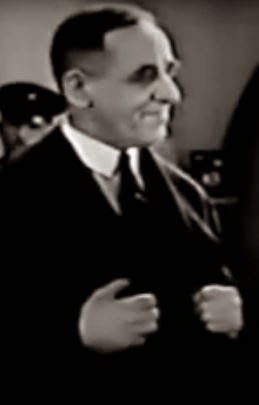
History for Sale illustrates Sam Bernard's signature in 1912/13 HERE and I'll close this brief visit to the Moon with what proved to be one of the last photographs taken of the first American to play Conan Doyle on stage, along with the inscription on the reverse.


Further reading:
Conan Doyle has a growing list of appearances as a character. IMDb has a useful collection of references HERE .

The history of New York Theatre (originally Loew's) is described HERE .

Vaudeville old and new has a biography of Sam Bernard HERE


    © Ray Wilcockson (2014) All rights Reserved

Sunday, June 1, 2014

"An Important-looking Door" - GCSE English Literature.

Richard Jutras as Owl Eyes in "The Great Gatsby" (A & E and Granada 2000)

“An Important-looking Door.” - GCSE English Literature.


“On a chance we tried an important-looking door, and walked into a high Gothic library, panelled with carved English oak, and probably transported complete from some ruin overseas.
A stout, middle-aged man, with enormous owl-eyed spectacles, was sitting somewhat drunk on the edge of a great table, staring with unsteady concentration at the shelves of books. As we entered he wheeled excitedly around and examined Jordan from head to foot.
“What do you think?” he demanded impetuously.
“About what?” He waved his hand toward the book-shelves.
“About that. As a matter of fact you needn’t bother to ascertain. I ascertained. They’re real.”
“The books?”
He nodded.
“Absolutely real — have pages and everything. I thought they’d be a nice durable cardboard. Matter of fact, they’re absolutely real. Pages and — Here! Lemme show you.”
Taking our scepticism for granted, he rushed to the bookcases and returned with Volume One of the “Stoddard Lectures.”
“See!” he cried triumphantly. “It’s a bona-fide piece of printed matter. It fooled me. This fella’s a regular Belasco. It’s a triumph. What thoroughness! What realism! Knew when to stop, too — didn’t cut the pages. But what do you want? What do you expect?”
He snatched the book from me and replaced it hastily on its shelf, muttering that if one brick was removed the whole library was liable to collapse.”

- F. Scott Fitzgerald, Chapter 3, “The Great Gatsby”


I thought of Jay Gatsby’s library in this week’s ‘unsteady concentration’ of news and views about GCSE English Literature, of that library and what it all seemed to mean. At least to me.

Library Open.

The current controversy is about books studied for external examination. In three decades of teaching to GCSE and A level I have never objected to a set text on literary grounds. I don’t now. Heads of English especially will appreciate the numerous exigencies that determine who teaches what; I won’t rehearse them here, except to recall personal favourites play little part in the process. I’d teach any text set or ratified by a board, as often or infrequently as required. Boards don’t select books they can’t assess. Either at GCSE or A level the texts set allowed me to educate students in the critical appreciation of imaginative literature.

Hence, one major thread of discussion this past week has been irrelevant. I refer to exchanges of opinion regarding the literary worth of (in particular) John Steinbeck’s “Of Mice and Men”. On the farthest limb of insupportable irrelevance sat the Tweet exhorting the generality to “Stop pretending...that “To Kill a Mockingbird” is canonical literature. It’s Oprah Book Club level.” This, in apparent ignorance of the presence on Oprah’s latest 2014 recommendations list of Tolstoy’s “Anna Karenina” and two Charles Dickens novels.
A related thread opined that the novella and Harper Lee’s novel have been “done to death” (in the words of one Tweeter). A variation on this theme has been to promote the notion that “stale” teaching is a consequence.
Now, I have probably taught “Hamlet” (having studied the play at A level and university) for two-thirds of my career. In my last college, I was, for several years, teaching “Hamlet”, “King Lear” and “Frankenstein” to both A2 and both A1 groups simultaneously, at variant places in the text and course. Every time was like the first - it was to the students and I made it so for me. Back in the ‘70’s when, as now, texts were slow to change (for practical, legitimate reasons), I decided never to keep last year’s course notes, never to attempt to reproduce historical responses. For me “Hamlet” is evergreen.

Equally, especially as Head of English, I felt it a responsibility to teach new arrivals on the syllabus. It didn’t matter what they were. At root, it’s simplicity itself to avoid repeating texts. If the teacher/department want to, they can. If the exam board is concerned about a text, it can replace it. If those who consider the American writers above to have been “done to death” one wonders why they fail to find similar fault with “An Inspector Calls” or, more prominently (it’s Hobson’s choice), the narrow range of Shakespeare’s plays typically on offer - probably narrower given the universal omnipresence of “Macbeth” and “Romeo and Juliet”. These have been ‘done to death’ - but only in the drama.

Content as I am with each book in the ‘libraries’ specified by the four GCSE exam boards, I have concerns about the librarians and for the readers.


Librarians and Readers.
In 2010, the traditional selectors of texts, the exam boards, were still actively responsible. This Independent article clarifies  by whom and how books were chosen. Since late 2013 (when This specification was published) all boards have been subject to a new hierarchy which delimits their traditional role. The lineage of that imposed structure reaches up through the DfE and Ofqual to the Education Secretary and, ultimately, the National Curriculum. Powers that, hitherto, have been brought to bear on education to KS3 and on the conditions of teachers are now (logically) focussing on our relatively infant exam boards, throwing them just as surely into reactive mode. These new draft specifications for English Literature are first reactions - and would not be in contemplation without the new DfE requirements, which are uniformly binding.

While I firmly oppose the National Curriculum, this is not the place to argue its merits. There are, by now, after all, too many who have never known anything else. I think, however, we can all agree the intention is to offer every student the best we can and that state power is a formidable thing which, when exercised, had better be beneficial. So, let’s assess the effect the state ‘librarians’ are having on our short ‘chain’.

The Chief Librarians.

There is, of course, a superfluous magnanimity in Michael Gove’s assurance he is banning no books and pupils, with or without teachers, are free (indeed encouraged) to read whatever they wish. We do not need to be granted a freehold already enjoyed. The issue is not freedom to read: it is what we are free to read for detailed study to be examined on at GCSE. To continue my library analogy, we are precisely concerned with the (hopefully extensive) larger “stacks” or pool from which examiners may from time to time select set texts.

That pool is described by the DfE in the following crucial passages of its 2013 document, the only quotation I need present here:
"Students should study a range of high quality, intellectually challenging, and substantial whole texts in detail. These must include:
-at least one play by Shakespeare
-at least one 19th century novel
-a selection of poetry since 1789, including representative Romantic poetry
=fiction or drama from the British Isles from 1914 onwards"
The opening sentence is general and embraces all literature written in English that satisfies the description. The second sentence enforces the inclusion of the range then detailed. In retrospect, perhaps, the authors regret (they should) placing so much responsibility on one word in the interpretation of intended meaning. It matters whether you take “include” to mean “wholly comprise” or “ensure present as part of the general range required”.
Another matter the DfE would be wise to revisit is the validity (not to mention imprecision) of the phrase “from the British Isles”. It’s a self-defeating inconsistency and an insupportable restriction. The specification elsewhere calls for breadth and depth of high quality literature but this phrase ironically jettisons everything written in English overseas in precisely a period of especially fertile flowering.  Contrast the 19th Century novel. I can think of no valid reason to limit the later period but not the earlier.
I’d expect both the DfE and Ofqual to query certain features common to all of the exam boards’  specifications if they prove not to be addressed in revised drafts.   
The Chain Librarians.
OCR, AQA, Eduqas and Edexcel published remarkably similar drafts this week. Most notably, not one offers any addition to the range signified by the four DfE requirements. Having accepted this range, all other stipulations automatically apply. No other reading will share the status of those texts to be examined for grading. Schools vary in the matter of wider reading at GCSE. The crucial point is that only the set texts will enjoy detailed study. This feature makes them special to all affected.
Boards offer variant numbers of choices (one wonders just why) but evince a striking unanimity in core selections across the board. So uniform is their common approach that I’d simply register with the one I’d worked with before, which has its bureaucratic advantages.
No board takes up the single opportunity to offer a novel written in English by a non-Briton - the 19th Century requirement would, for example, be unimpeachably met by the inclusion of one of the best novels I know that illustrates the consummate ability of a writer to limit the broadest of personal vocabularies in the appropriate creation of an illiterate narrator: “Huckleberry Finn”.
Whence does this lost opportunity derive? Four ‘librarians’ in my chain made the same decision to restrict the 19th Century novel ‘shelf’ to Britons. Why? This is the first draft of a very different GCSE and at the very least this omission sends out a signal that non-British 19th Century novels in English are off the radar, possibly as permanently as the post-1914 prose and drama of America and elsewhere.
Is this really the intention enshrined in the DfE document? Have the boards collectively misunderstood, wilfully introduced restrictions, or frozen their reason in play-safe mode? Has the penny fully dropped anywhere in the hierarchy of librarians that they have contrived to disenfranchise great swathes of literature in English, reduce the total pool of potential texts for detailed study, implying the irrelevance of decades in which the world came to appreciate English literature was most fruitfully defined as  literature in English? Surely, as M would say: “This will not stand”?
With power comes responsibility. If this week’s statements from Michael Gove and the DfE represent the state’s intentions then the exam boards have not yet reflected them. Those who exercise power to instigate changes in the content of examinations may refer critics to the subordinate boards but this relieves not an ounce of responsibility for this (thus far) unedifying, divisive enterprise.
No doubt, syllabuses will develop with time and experience. For the moment, to ensure GCSE English Literature heads in the only legitimate direction is simplicity itself. I should feel more sanguine if reference to the British Isles is promptly removed and (as a token of intent) all boards extend text choices of 19th Century novels and post-1914 prose & drama to include works written in English beyond these shores.
The Readers.
How (as a librarian or reader) you perceive what constitutes literature in English influences the nature of response to poetry, plays and imaginative prose.
Literature in English is a democracy. I may be a Shakespeare specialist but I am wired against the notion of canons which seek to classify by comparative worth, authorial nationality or gender works of art that only exist when experienced in the mind of a receptive, observant, unprejudiced and thoughtful reader who is so sensitised to language that imagination is engaged. People are not normally called upon to justify their existence or prepare strangers with a bite-size “Guide to Me”. Artists, musicians and writers have fashioned what they ‘mean’ in the finished work and (rightly) balk at superfluous ‘explanation’.
I want to take the blog reader back to Gatsby’s library to illustrate why I view the current approach to set texts as a recipe for shallowness not depth concocted by the very people who should and I’m sure do know better.  The books are found indeed to be “real” - only in so far as they contain physical pages. That they are patently unread is evidenced in their uncut virginity. The man with the owl-eyed spectacles concludes this illustrates the fullest extent of Gatsby’s purpose in assembling a library. No book, of course, of any kind may exert any discernible influence on life unless someone cuts the pages and reads. The point is that we have here (in the emphasis on display and, for many, symbolic personal mystery in Gatsby’s motivation) just one example of the multiplicity of common obstacles in the way of direct experience of a book’s potentially real “reality”.
English teachers are all too familiar with these obstacles, usually erected by students themselves. A film or particular stage performance may precondition or usurp the centrality of  reading experience. Biographical, historical and cultural backgrounds may dominate the foreground. Bewitching incidentals such as an undue attention to authorial nationality and gender effectively delay ‘the cutting’ of any ‘pages’ let alone those of authors summarily dismissed as ineligible. The very library shrinks, cowers. Those tomes surviving the nationality cut do not celebrate; they brood, ashamed. They do not expect a fair hearing.
These obstacles relate to one of the central problems I’ve encountered over the years in the way students approach set texts. I call it:
The Tyranny of Theme.
Strictly, I mean more than theme but the word suffices to extrapolate to other manifestations of this phenomenon, notably in the treatment of character, imagery and natural description by literature students.
The sooner a student appreciates the difference between imaginative literature and its close sisters, history and biography, the better. Put simply. literature creates what never existed in ordinary life while history and biography seek to recreate and record. There are fascinating hybrids. I  once troubled to check all the libraries from Birmingham to Dudley to see how librarians had classified Laurie Lee’s “Cider with Rosie”. ‘Fiction’ or the Dewey 800’s or ‘Biography’ were equally represented. I also found it in folk tales (of the Cotswolds), agriculture, gardening, crime and on the history shelves. Lee’s raw material may be his own childhood but it is consciously imparted through novelistic means. It is as metal re-forged. This in itself seems to me depict how the adult Lee feels in recalling distant days.
The tyranny of theme feeds on an approach to literature borrowed from the reading of history and biography. Information and themes are mined, extracted and noted that are only meaningful, only breathe, in the context of the world in which they were created. GCSE bitesize revision notes (of ancillary value) service this perceived need. I have noted in a previous post the (entirely understandable) anxiety of A level students to collect from teachers and elsewhere handy prepacked ideas they can use in exam answers. Even the definition and recognition of literary terms often places cart before horse, insulating the reader from fulsome experience of imagery in the raw.. Characters, relationships and themes are neatly tabulated as akin to ‘facts’ while natural description is all too often undervalued (and skimmed) as ‘decorative relief’ or ‘setting’.
Closing Time.
Teachers of English literature thrive on depth and breadth in the study of poems, plays and prose and they’ll willingly cut the pages year after year in an ever-expanding library. They deserve an external exam system that draws its water from pure springs - whatever the source. If Asda, Tesco, Sainsbury’s and Morrisons reduced their range of flavoured bottled waters in unison to ‘Raspberry’ alone,  there’d be trouble at t’super market.
I simply hope for a system that unequivocally acknowledges the centrality of direct imaginative experience operated by people who demonstrate they have not forgotten the life-long insight and delight derived from realising  why, in the second chapter of “Sons and Lovers”, following the kicking of WIlliam, D H Lawrence chooses to take Mrs Morel “out over the sheep-bridge and across a corner of the meadow to the cricket ground”, there to sit, statuesque as Leontes’ Hermione, as the narrative moves to sustain over several prolonged paragraphs a heart-breaking empathic chorus of  natural description.
I want to sense examiners consider the nationality and culture of (say) Henry James of negligible interest in comparison with a transparent encouragement of students to wonder why William Golding’s “Lord of the Flies” island is so aptly peopled entirely with males. Especially do I hope for a focus that supports a GCSE candidate's emergent sense of form, that values the novella or short story for what they are - the most appropriate vehicle for the author’s imaginings, rather than stalled novels. “The Great Gatsby” was longer in first draft - the final “cut” is a gem. It’s on my shelf, filed alphabetically, smiling out between Fielding and Forster. All its pages were cut long ago. I like my libraries fully open, vast and real.

© Ray Wilcockson (2014) All rights Reserved.

Sunday, May 4, 2014

"No Staffroom for Old Men" - A View from Over the Bridge.


When we retire, we cry, that we are come to this great staffroom in the sky.

Saturday 3 May, 2014.

It's years since I attended a gathering of teachers but today's ResearchEd in York was streamed live and I took the opportunity to listen to some fellow Tweeters. The day proved to be about far more than its title suggested and I'll examine why in due course. First, it seems useful to take the reader back in time to...

An 80's Staffroom.

I was already retired when the Gove Glacier scoured its relentless way down the valleys of education and, for one who loved and misses the classroom, it is bitter-sweet compensation that I'd neither want nor feel able to teach under the current dispensation. It's no country for this old man.

By 1988 I'd moved into 16-19 teaching, so never taught to the National Curriculum. Even so, the college staff experienced winds of change with regard to the treatment of staff, small in themselves but indicative of things to come.

First, something novel began appearing in pigeon holes - the memo. A new senior appointment with an office just down the corridor chose to write (typed!) what was easier to say in person. I watched colleagues bin missives in astonished distaste. The penny - eventually - dropped that this was a college where teachers talked to one another.

One glorious summer 3 days of INSET at the end of term took the whole staff to a venue owned by freemasons. Lodges don't have windows. A sweating, seething staff is not a pretty sight. Nor was the bill for rooms, refreshments and (uninspiring) speakers. That April had seen capitation cuts; ring-fencing for such INSET extravagance was savaged in full staff meeting and College Board. In future we ran our own, bespoked to our own agenda, for free, in college.

Successfully too, we fought what I see now as a rear-guard action in defence of regular full staff meetings. Noting a decrease in frequency and a tendency for senior management to select and monopolise items that talked at a passive audience, we reclaimed both regularity and agenda.

When I left that college for (Welsh) pastures new, someone paid me one of my most cherished compliments. A young Chemistry teacher in his first year asked for a private word after the 'Goodbye' do. We had never had reason to speak before, he said, but he just wanted me to know things I'd said in full staff meetings had given him strength, faith and inspiration to stay in teaching. I'd given expression to matters he realised he valued. He was not to know this was precisely what had happened to me long before in 1969.

A 70's Staffroom.

My first colleagues (for 5 years) inhabited the staffroom of a 3-form entry, 11-18, selective technical school. I returned to the school after secondment for a similar period, when, after the 1974 reorganization, it had re-opened as a 6-form (sometimes 8) 11-16 comprehensive. Despite their differing sizes, each staffroom operated as engine room, mess and recreation decks in every teacher's daily life. 'Embrace the mess" says the mantra. We did. And cleared it once (Augean-style) at term's end. This was the epicentre to which all gravitated. Departmental staffrooms and individual work stations neither existed nor were desired. You might mark in quiet for half an hour in an empty classroom, but you'd return to where the action was, quite naturally.

Here were the all-important notice boards (pigeon holes were mostly for post): sports teams, union notices, calendar...and, crucially, the only copy of the whole timetable next to 'cover for the day'. This last you checked frequently: we did a lot of cover, often at short notice, in those days. To be based in the staffroom, there to do my marking, grab a bite and field issues as they arose was just as essential when I later headed the English department and its parent area. Practical.

But this environment offered so much more than mere efficiency. It sustained a natural continuum of direct human association. If for a moment I think of a school as a living organism, that first 11-18 was the healthiest I've known. The presence of a sixth form seemed to me doubly beneficial: younger students are daily in the presence of those who people the spectrum between themselves and professional adults. For the teacher, I hold that the frequent shift from an A level class to one of (say) 11 year olds enhances the clarity, depth and sensitivity brought to both age groups. One lives and absorbs the range. However, this is not, for the teacher, enough.

The beauty of such a staffroom as I describe is the essential, extra dimension afforded for adults to be, as naturally and as often, with other adults. And these are not just any adults. They are the teachers who currently, or did, or will teach the pupils in your classes. To rub shoulders with these people is to experience something of the daily, yearly and whole-school experiences as each pupil perceives them. Your own staff are a teacher's second best resource (after yourself) because their knowledge of these children is localised, specific, current and professionally filtered.

Almost all I know about teaching was derived from personal observation, trial and error and a process of natural absorption of my colleagues' insights and experience (which included their teacher training, as I had none). Staff meetings were riveting. They were my chance to listen to wiser heads speaking their minds without fear or favour and to consider (silent at first) just where I stood on the issues of the day, arising, with agenda priority, from the staff.. This was INSET at its most dynamic and meaningful and (with the honourable exception of a course on Listening) I have only ever really valued full staff meetings and such home-grown initiatives as that of our remedial department in this school's comprehensive incarnation.

The purpose was simple: give all staff first hand experience of what it felt like to be totally out of your depth in a lesson. Along with other heads of department I taught half a day of the most difficult concepts I could think of in English (Eliot's theory of the objective correlative, Metaphysical poetry and the like) to 30 non-English staff and spent the other half as 'student'. Raw, chastening experience. Lesson noted. But, oh! How we loved watching our talented colleagues in their chosen calling.

In Praise of the Informal.

 A visitor to the staffroom I describe would not. I hope,  have been fooled by its characteristic  informality and apparent chaos. Mankind may not be able to bear much reality (and teachers certainly need a break from their pupils...and vice-versa) but people thrive on variety and relish hard work that is engrossing, owned, valued and leaves wriggle-room for human warmth. Thus, just this week, I watched a programme featuring two water workers doing the worst job in the world (clearing sewers) with good spirit and a camaraderie that made light of it all, rounded off with a pizza binge. What people cannot bear, for long, is a bland diet of unrelieved formality.

The formal register has its place. But, in the staffrooms of my earlier career, many an issue was put into perspective and settled without undue formality. This effectively fielded and aired concerns about pupils that were not so serious as to warrant formal notification, concerns that may never see the light of day or suffer exaggeration where the absence of a working staffroom necessitates arranging a special meeting in someone's office.

The working, united staffroom can seem a fearful place for senior management - the less they experience it, the more distantly formal they grow. (You see where I am going).

It need not be so. In that first school, there was some concern that our Head, returning from extended sick leave, might not be quite ready. One busy morning break, he popped his head round the staffroom door and summoned me, by name, loudly, from the far end of the room.

"Mr Wilcockson! Come here, if you will!"

The tone was serious. Jaws dropped. Elbows nudged. He watched, they stared, ominous as les tricoteuses at the guillotine, while I traversed the crowded room.

"Your shirt's hanging out." A cherubic, mischievous laugh and he was gone.

With one superbly timed moment of disarming humour he had allayed all fears, shown he was at ease with the staff at large and (a personal bonus) transparently happy with my work, having no formal issue to raise. Quite how he would have achieved this instant restoration in a school without such a staffroom defeats me.

Comrades and Colleagues.

One Autumn evening, that same head could be found, happy as Larry, standing on the slack in my coal house supping a pint in deep educational discussion with a motley assortment of senior and junior colleagues. It was the 'after play party'. The house being full, they'd taken to the back yard.

I think on reflection now that it was because the staff of that school (as selective and comprehensive) lived cheek by jowl, knew each other so well, met in a united staffroom and owned their gatherings, that they naturally, readily participated in school life outside the academic day. It is utterly appropriate in a profession that is a humanity (and not a business) that its practitioners have the freedom to exemplify in their own lives that absorption in cooperative experiences (in classrooms and everywhere else) which makes for happy living and learning.

Just as students are much much more than their grades, so teachers are not to be defined by their labels. When I sat down with Brian to write large-cast plays for our school drama society, he wasn't Head of Maths. When pupils rehearsed alongside teachers and parents and then performed "The Crucible", something else had melted away - temporarily irrelevant formal distinctions of age, of status, of skill. You cannot "teach" these things, still less formally "require" them - they have to be experienced and are only born from a body of teachers who are free to be comrades as well as colleagues.

In short we had energy to play with because, individually and collectively we enjoyed and took seriously the autonomy of professional trust. Work-life balance isn't an issue for those who possess work-life integration. The skies were emptier then.

Truth to tell research played little part in our lives. New ideas, supplementing initial training, tended to come with new appointments or were introduced (with the lightest of touches) by LEA advisers. If they gained currency, it was through gradual testing, modification and absorption not prescription. Sometimes I wish the internet had existed, for access to new thinking is so much easier nowadays. On the whole though I believe we were doing other things which felt wholesome and worthy, things ideas alone can never achieve.

The Research Movement.

I choose this wording as a catch-all for more than the event at York represents. Since 1988 educational research has received unprecedented attention because recourse was made to (some of) its findings to underpin governmental and business re-modelling of education.

The first thing that strikes me about such teacher-owned initiatives as ResearchEd is that it is a response in kind to the above, born of the dawning realization that not all research is good and some is downright dangerous. Under Gove especially we witness a side-lining of both LEA & College of Education expertise, in favour of centralised dogma. ResearchEd engages the government on its chosen ground as well as (admirably) providing teachers with resources and a forum for patently enthusiastic, critical thinking about their practice.

I do not think this is going to be enough; nor do I observe this to be the only significance of ResearchEd, which has much to say also about the importance of re-validating and re-empowering the Teacher's Voice.

The teacher of today is in the ironic position of having instant access to a world-wide, virtual staff, but far less everyday association with the real one in his or her own school than I was afforded.

I read of new schools built without staffrooms, of existing ones converted to classrooms, teachers isolated in subject base and office or in the constant company of pupils in and out of lessons on the justification that every moment is deemed formal work. I maintain that your own company is not enough; that association restricted to your own subject staff effectively blinkers a broader, richer, participatory relationship with your school; that unremitting proximity to children and 24-hour exposure to anyone (SLT, student, parent) who thinks it's OK to send you a faceless memo by e-mail) are thoughtless, inhuman and debilitating. Whether by insensitivity or design such arrangements effectively dismember the body of the staff and silence its common voice.

A student teacher I know has been a term at a local school. There are two "briefings" a week (before school). He's never heard the Voice of the Staff. What sort of society is that?

I can think of no better word than "joy" to describe the exhilaration sensed in those tweeting and blogging gleefully from York (and, for that matter, staying up late at night to blog themselves to sanity and simply connect). Enthusiasm for new ideas, but JOY for the unclouded skies of camaraderie. And I would ask this question: if this level of elation is rarely if ever felt back "home" with your own comrades in arms, why not?

A specific idea seems to have emerged from this weekend's 'staff meeting' in York - that it would be great to have someone in each school with research responsibility. Such a green shoot will flower in fertile ground. At the moment (as ResearchEd and Teachmeets illustrate) such suggestions come from and are valued by real and virtual extra-mural 'staffrooms'. How fertile is your own? My own sense, for what it is worth, is that on the only ground that really matters - the school you teach in - what's needed at root is the propagation of that joie de vivre that suffuses a staff and a school at ease in humanized systems.

In "The Phoenician Women" Euripedes writes: "This is slavery, not to speak one's thought." I hold, therefore, that the dissolution of traditional arenas for the shared ,confident and valued articulation of teachers' views within schools is an enslavement. There is no generosity in the specious charity of giving teachers "freedom" to choose how to teach while disenfranchising them in every other aspect of the profession. Critical thinking brooks no boundaries and to abuse the teacher's freedom of thought and expression is merely to teach children there are only certain matters about which you are "free" to speak.

No wonder teachers leave. Who would bear the whips and scorns of such a time and the oppressor's wrong for long? Well, teachers would, and do. Until body and spirit just give out.

This must not for long remain the way of the world.

The Great Staffroom.

No more marking. That's what you notice. First. When you arrive.

No bells, no dates. No cover to do or meeting to attend. In place of nights of preparation: sleep and memory.

There are many of us but it's quiet here, the room as vast as vast may be. We are all here. Together.

I came quite recently, having served the last three decades of Century 20 (aka The Blobocene Epoch). Former colleagues, I am aware, are here too. Not that we meet: you have to be doing things for that to be meaningful. We remember, each, what was done. That is enough. Anyway, all but one of my schools no longer exist. We are but legend.

On my daily walks no doubt I chance upon one of your own school teachers, exchange pleasantries with those who taught our country's politicians. They all care. It is rumoured Plato himself has been seen to pause a moment near the bridge on the way to the Gymnasium, deep-browed in furrowed thought.

The ghosts, too, are here. I feel them.

Such is the Choir of Caring - no teacher is ever alone.

It is Milk Wood here across the bridge.
Listen. Listen.

"Sudden in a shaft of sunlight
Even while the dust moves
There rises the hidden laughter
Of children in the foliage
Quick now, here, now, always." (T.S.Eliot "Burnt Norton")


 © Ray Wilcockson (2014) All rights Reserved.

Tuesday, April 8, 2014

The Promotion of Friend Lestrade.


Inspector Lestrade (Colin Jeavons) in Granada's 'The Six Napoleons'.

Friend Lestrade.

"The Six Napoleons" is one of my favourites in the Granada Holmes series not least because it is THE Lestrade episode. The hour begins and ends with a masterly triple act performed by Brett, Hardwicke and Jeavons and the still above represents a passage of consummate, largely silent comedy roughly halfway through the story. Finding himself alone in Baker Street, the Scotland Yarder (we just know!) half-imagines himself to be the Great Detective, trying, as it were, Holmes's armchair for size (and inspiration). Holmes and Watson join the eavesdropping audience as Lestrade gives way to temptation,  peeking (unprofitably) into a folder of private papers.

The exquisite, moving 'handshake' epilogue confirms the greatness of Colin Jeavons' performance, the promotion of Lestrade to most significant policeman in the Canon, to the status of "friend" and to an acting role coveted by the best of our actors. I think it a direct consequence of Granada's creation that Lestrade's torch burns so bright this century in the capable hands of Rupert Graves, Sean Pertwee, Eddie Marsan and Mikhail Boyarsky.

The Jeavons portrayal confirmed Lestrade as Chief amongst Doyle's Inspectors on film and faithfully reflected the character's association with Sherlock Holmes over two decades, despite adapting but five of the thirteen Canon stories in which he appears (and transferring him to CREE).

[Aide memoire: Jeavons appears in NORW (1985), EMPT, SECO & SIXN (1986), CREE (1991) and THE MASTER BLACKMAILER (MILV) (1992). Click HERE for a list of Canon appearances, noting that, before FINA in the Canon, Lestrade appears in STUD, BOSC, NOBL & CARD; before FINA ep 13 in the Granada series he is introduced and only features in NORW ep 10. ]

Excellence of acting, aside, (for me) Granada's appreciation of the nature of short story renders this portrayal of Lestrade unsurpassed. I know of no other production that understands so clearly what a short story is, how ideal it is in form for the Sherlock Holmes series (not serial) and how it may most fruitfully be adapted.

Reading the Clues.


"If any little problem comes your way I shall be happy, if I can, to give you a hint or two as to its solution.” Holmes to Lestrade SIXN.

Short stories are the sonnets of prose fiction. Just as the fourteen line poem is not an incomplete ode, ballad or epic, the minimalist painting is a finished work. It was Doyle's express intention when first writing for The Strand to create stand-alone detective stories. Order was immaterial. A story was one case and he hit upon the ideal narrator in Watson and the most flexible, potent format-  the reminiscence - through which to record "any little problem". The short story, not the novel, is the classic Sherlockian form.

Consider the elegant parallel of the problem presented,  the "hints or two" to a solution and the mode in which short stories work upon the reader. "The parallel is exact". There is about the construction of the short story the same severe discipline that Holmes brings to his arrangement and examination of "the facts" and an identical requirement (on detective and reader) to hypothesise, expand, deepen and flesh out. Doyle's art lies in his intuition for saying just enough and no more to feed the reader's imagination. He does it with scene-setting, descriptions of weather and, most relevantly here, with characters. It is also no accident that the Canon is eminently quotable - Holmes is given to aphorism which is harmonic with the chosen prose form and theme of detection.

The Granada team fully comprehended that a short story comes alive directly in the reader's imagination. A  play script on the other hand comes alive via performance by actors. In adapting fiction for stage or screen account must be taken of these crucially different modes of experience. Brett's performance is emblematic of how Granada's script writers found a filmic equivalent to the "hints" a reader would normally expand, deepen and flesh out alone. He is all gesture, expression, exclamation and posture designed to convey quanta of information far beyond the simplicity of the action. The "mind palace" of Benedict Cumberbatch's Sherlock is externalised in on-screen captions; Brett's technique of hinting (yet just as wholly communicating) is closer to the Tardis which is bigger inside than it seems from without and a closer parallel to Doyle's own method.

It is in this fertile context that Inspector Lestrade leaps so readily to life in the hands of a highly skilled actor and the scene with which I began this post is example of how, with the minimum of actual appearances in the series, the portrayal is yet so potently brought to the screen.

The Ladder of Promotion.

Frank Finlay as Lestrade in "A Study in Terror" 1965 Compton Films.

Other adaptations may not be as sensitive to the nature of the short story but have contributed significantly to the elevation of Inspector Lestrade to the status he now enjoys. Jeavons stood tall on the shoulders of others who had gone before. I rate, for example, Frank Finlay's performances in 1965 and 1979 and have a nostalgic soft spot for Archie Duncan, Lestrade and Little John of my childhood. However, I should now like to focus on the other significant moment in Lestrade's cinematic history when he earned a belated promotion after years of obscurity and made the part attractive to actors of Finlay's calibre and a source of daily bread for journeyman Duncan.

The Lean Years.

The first three decades of the 20th Century were barren years for Doyle's policemen. Of the four stage plays by ACD and/or William Gillette, only 1910's "The Speckled Band" requires a policeman - "Inspector Downing" - with the tiniest of roles. The silent era employed John Willard as 'Inspector Gregson' in Barrymore's 1922 film, the year after Arthur Bell's 'Inspector Lestrade' for Eille Norwood in the shorts: NOBL, RESI, EMPT & TIGER. In 1923, Tom Beaumont covered all three detective roles ('Lestrade', 'Gregory' & 'Taylor') in  Norwood's versions of MAZA, FINA, LADY, CARD & SILV.

The rest is silence - Friend Lestrade remains as obscure and distant as Joseph Alexander Lestrade of St Lucia. Generally understood to be the man who lent his name to Doyle's character, Joseph was an acquaintance in Edinburgh and took his degree (Bachelor of Med & Master of Surgery) in 1883, two years after Doyle graduated. It would seem he returned to his native island and I believe I find him there in 1904 as "Joseph Alexander Lestrade M.B.C., Q.M., Colonial Assistant Surgeon", residing in the original capital, Soufriere. There are unspecified charges against him in the National Archives for 1905 - no doubt he encountered a policeman.


Philip Hewland as Inspector Lestrade.
Charles Mortimer as Inspector Lestrade.
The (talking) thirties had, naturally, a growing pool of experienced film actors. While the performances are limited by that traditional focus on Holmes and his villain attributable to William Gillette's influential play, seasoned actors like Philip Hewland & Charles Mortimer ( for Wontner) and Alan Mowbray (for Owen) brought considerable stage and screen skills to what remained two-dimensional Inspectors.


 "Forever two long steps behind “Mr. ‘Olmes”

Yes. Dennis Hoey.

The first real step-change, the first secure move up the ladder of promotion may be observed in the six Universal Films made in 1943-6 starring Basil Rathbone and Nigel Bruce. Unsophisticated as the characterizations may be, both Doctor Watson and Inspector Lestrade would never be the same again. Bruce and Hoey were famous, illustrious and well-loved actors of stage and screen and (modestly, I feel) restored their fictional men to the status Doyle intended. "Lestrade's little cock-a-doodle of victory", you might say.

Friend Watson & Friend Lestrade.
Dennis Hoey, born during the Great Hiatus of 1893, is the first performer of this part whose name most people know. I shall not dwell on the Universal Films except to note Lestrade's banter and humour with, especially, Dr Watson illustrates hitherto untapped possibilities in this role.

What may not be as well known is that Hoey was extremely versatile (He played Rochester on stage and his appearance as White Chief, Mala, in 1937's "Uncivilised" may be viewed HERE ) . He was an excellent singer, creating the part of Ali Ben Ali in the first stage production of "The Desert Song". In a delightful coda to his film career Dennis Hoey got to play Sir Arthur Conan Doyle in the 1956 Omnibus television programme "The Fine Art of Murder" also starring Rex Stout as himself.

I shall end this lengthy post with two delights: a British Pathe short from 1930 of Dennis Hoey singing AND a moving, fascinating reminiscence of the man by his son, Michael. Do read it.

The film link: HERE

Michael link: HERE

N.B. The following link will take the reader to an excellent IMDb list of Lestrade Films: HERE

“Look at that with your magnifying glass, Mr. Holmes.”


© Ray Wilcockson (2014) All rights Reserved.