Saturday, October 25, 2014

"This day is call'd the Feast of Crispian" - Shakespeare's Band of Brothers.

"Henry V" 1989 (Renaissance Films, BBC & Curzon Film Distributors).

"'Tis good for men to love their present pains
  Upon example; so the spirit is eased:
  And when the mind is quicken'd, out of doubt,
  The organs, though defunct and dead before,
  Break up their drowsy grave and newly move,
  With casted slough and fresh legerity."  [King Henry V, Act 4, scene 1]

Present Pains.

In the small hours before dawn, weight of "present pains" have all but paralyzed an English army patently outnumbered. Shakespeare's great Agincourt act prefaces the battle with two scenes from the English camp aptly disjointed by a visit to the French, for whom defeat is so distant a prospect that they give, with "fresh legerity" and levity, all imaginative fuel to derision of an enemy hardly worth the effort.The Constable scents his quarry unerringly:

"Do but behold yon poor and starved band,
And your fair show shall suck away their souls,
Leaving them but the shales and husks of men."

An arrogant Grandpre quips that:

"Description cannot suit itself in words
To demonstrate the life of such a battle
In life so lifeless as it shows itself.

Henry's present pain is to find the words to "newly move" his men; Shakespeare's is to make this credible. Both are achieved and blaze through the present, quotidien tense of:

"Let me speak proudly: tell the constable
We are but warriors for the working-day."

From Casted Slough to Fresh Legerity.

[NB: Act 4 may be consulted HERE ]

The key speech (the focus of this post) is also the most famous and hence often quoted out of the very context that shapes it, masking its improvisational nature. It is triggered by overhearing an English voice (presently identified as Westmoreland's) bemoaning the lack of soldiers. That Henry's response is spontaneous is evinced in the exclamatory oaths that characterize the preamble to mention of saints' day, an appeal to honour that leads him to the risky proclamation:

"That he which hath no stomach to this fight,
Let him depart , his passport shall be made,"

But we (and Henry) know a king's "affections are higher mounted" than those of ordinary men, Fresh in his memory must be the bluntly honest response of Michael Williams at mention of the honour of dying with your king: "That's more than we know."

At this juncture in his reply to Westmoreland, a wider audience exerts its presence and must be summarily addressed. What word does Henry have for the common man? What sustenance in an hour of greatest peril? And what language may be found and understood?

Like tributaries tumbling to a stream, recent experiences meet the exigent present to precipitate one all-embracing vision, easing the spirit, be he low or high, in a blank verse tutored by the prose of Harry Le Roy, ennobled as befits one who has just that night mused uneasily upon:

"What watch the king keeps to maintain the peace.
Whose hours the peasant best advantages."

Not the rhetoric of chivalry nor the prose of his disguise but an inspirational fusion that sets the present afire. You don't get blank verse any simpler or so potent an enactment of spiritual renewal when, where and with whom it really matters. Here is the real battle and it is won. The rest is in God's hands.

This is the natural, rhetorical music of the Aeolian harp - "Twin-born with greatness" finds its authentic voice. Without scene 1's philosophic soliloquy (couched in verse)  on the condition of kingship; without his (disguised) acknowledgement to Brother John Bates that : "I think the king is just a man."  we should the less appreciate Henry's speech as the manifested expression of a long night's uneasy vigil. He has observed courage of kinds in Pistol (even Bates) and Fluellen (in the latter, too, a reminder of self-respect). But how to harness it? How, more intransigent still, to accommodate the myriad concerns of "private men", like Bates, Williams and Court, who put widows, orphaned children and unpaid debts before the fate of kings?

Fellowship.

  They say words spoken haunt the air invisible well after utterance. Cousin Westmoreland (and scene 3's other lords) occasion both Henry's initial theme of honour and serve in its development. We met them in scene 1, greeted variously as brothers. Bates was so named, and, for a while, under the name of Harry Le Roy the king bandied words on equal footing with a Pistol who thinks his monarch "A lad of life", seeding memories for him and Shakespeare's audience of Hal.From such traces of the prince of yore comes unbidden an expression of the warrior's valuation of fellowship that prompts the Crispian vision. It is the royal plural, but:

"We would not die in that man's company
That fears his fellowship to die with us."


The Henry of history appreciated only too well the synchronicity of fighting the French on October 25th. When he was yet a prince, the town of Soisson in nearby Aisne had witnessed a massacre that had shocked Europe. He claimed after Agincourt to have avenged rhe honour of its saints, Crispin and Crispinian.

Neither I nor anyone I know celebrates St Crispin's Day. I suspect most of us solely associate the name with Henry V and even then know so little of its origin that few are aware two saints not one are involved. Legend has it the brothers were twins, Christians beheaded as martyrs (see Wiki entry Crispin and Crispinian ). "Henry V" Quarto 1 (1599) opts for 'Cryspin'  (see Q1 ), while modern editions tend to follow the First Folio (1623) with 'Cryspian" (see F1 ). While an extra vowel regularizes the verse, I do not think this the whole effect. The Folio prefers "Feast of Cryspian" to the Quarto's "day of Cryspin" emphasizing the ritualistic aspect. The Folio's name effectively fuses the saints into one, while, at the same time, drawing attention to the duality by adding a new line:
"And Cryspine Cryspian shall ne'er go by". Such is the icon offered of this band of two brothers.

Shakespeare's dramatic recourse to this story of martyrdom provides his Henry with the example he reaches for to convince his men to "love their present pains". They desperately need a narrative that unreservedly ousts  the doom-laden story they have told themselves. Duty to the king is not at issue; what is is the universal sense this is nowhere enough.

Vigil and Feast.

If I had to identify the dramatic beginning of St Crispin's Day, I should point to my post's title quotation. There is an alternative in that, for the French of scene 2: "the sun doth gild our armour". For me, the latter is the false dawn of a counterfeit day; the former the much more significant onset of reality. No one, French or English, has mentioned the saints before. Both have passed the same night in superficially similar ways - militarily speaking, vigil has been kept. But while the French have otherwise squandered the time in scornful amusement, English wakefulness has been purposeful. This Wiki entry on Vigil elegantly illustrates the range of relevant resonances and highlights Shakespeare's dramatic plan: Act 4, scenes 1 to 3 are, synchronistically, preparation for war and a devotional for souls.

All King Henry is doing when he states "This day is call'd the Feast of Crispian" is to acknowledge the grim truth of the night. We understand perfectly Shakespeare's emphasis on forlorn hope in the face of overwhelming odds. It is precisely this sobering fact that has brought the English (king, noble and commoner), but not the French, to a last ditch concern not for the condemned body but for the state of the soul. Each in his way has illustrated the king's words to Williams: "Every subject's duty is the king's; but every subject's soul is his own." Henry's achievement is to herald the end of the vigil and commencement of the feast at the ripened moment, not by design, but because of what he is, has observed and meditated upon. He already speaks for all. By contrast, given the unshriven state of the French and the carnage that ensues, their final toll transcends mere numbers dead.

It is vital for a full appreciation of the dramatist's intent that we bear in mind the connotations of a religious feast. THIS refers to the opportunity afforded for ritual reenactment which imbues a community with meaning and cohesiveness. The italicized word is dramatic and relates this theatrical Feast of Crispian with the church and early medieval drama. Drama enacts. Shakespeare is no bishop. He does not presume to ape the liturgical. What he does set out to do is to "newly move" the audience with a potent vicarious experience that, as it were, refreshes the page of life and community through imaginative absorption in an old story brought to palpable life.

Shakespeare's Band of Brothers.

 What I have called The Crispian Vision transcends both Henry's appeal to honour and the disquieting miscellany of personal preoccupations that characterized scenes 1 and 2. From its first clarion use, the word rings crystal clear - not crisp as the morning air - it is the inspiration.  Aptly, the repetition, "Cryspine Cryspian" has a military measure striding implacably:

 "From this day to the ending of the world".

To the tune of Crispian, Henry rough-hews a succession of vignettes that draw the mind away and beyond the present. Templated by the annual united tribute afforded martyrdom's famous brothers, their king previews the feast of lasting remembrance mutually assured for all who live or die with him, not for one lord or self but as one band of brothers.

This is no time for palace imagery, let alone a doleful sitting down to tell sad stories of the death of kings. The French await; the Pistols of this world shuffle and scowl. So Shakespeare lends Henry his own celerity and lightness of touch (legerity). Alert to the occasion's limitations, the king sketches as a general might scratch battle plans in the earth. Each brief scenario, given authority (and prophecy) by formal verse nevertheless is plain-as-pike-staff in diction. Stood "a tiptoe" right now, primed for action, no man could not relate to the swelling pride imagined in whoever came safe home to hear the name of Crispen spoken there. All could readily visualize some future, quieter vigil evening when the morrow's named with pride at gatherings and, like a risen Christ, he who was there may show the wounds he had on Crispin's Day.

Though some will die, all will be household words: such is the bond that binds a self-selected brotherhood of peers. Only Shakespeare can so assuredly make music of a simple list of names. Except old men. Nobles, soldiers, audience alike are invited momentarily to sit by the fireside in hovel or manor farm and hear "the good man teach his son" the story. What need to tell it now when they who listen live it as he speaks?

Dramatically, Crispen was initially invoked as a familiar icon of the spiritual vigil undergone before this battle. Now the example is of enduring remembrance, guaranteed to those of any rank who'll shed his blood for the few. And they are happy - in a felicitous state because all are indistinguishably one. Such is the lightness of touch that we delight in catching the muted pun in "gentle...condition". Puns are by definition synchronous - how apt that the assurance of equally esteemed status for all should coincide with the sense of troubled spirits eased by authentic care in the face of death.

The king's vigil (to name scene 1) served to reconcile regal status with Henry, the man. An audience should sense the irony of a king disguised as a man, for what is a king but a man in disguise? While the monarch of that scene aptly soliloquizes concerns that are his alone, the man, represented by reference to "Hal" and "Harry" explores and craves companionship. The speech under discussion miniaturizes this duality as it moves from the (ironic) solitude of the royal plural of:
"We would not die in that man's company"
to the brotherly plural of "We few, we happy few".

Shakespeare creates a rhetoric that is credibly impromptu (seemingly arising ex tempore) in part through unsophisticated vocabulary, but mostly through repetition, the first recourse of oratory. But it's a doubly effective device in that repetition is multiplication. While one shape of the speech is diptych (noble isolation/common fraternity), another is insistently expansive, as the ripples stir a still pond with one pebble. "We few, we happy few" encapsulates the essence of this imperial theme and almost paradoxically increases "few" with its repetition.

A drama only lives in performance and then solely within the active imagination of spectators. I would suggest that for them a full appreciation of who may be counted in the ranks of "we happy few" is a cumulative gathering. Two brothers who die with each other. A king. His noblemen. Those who will stand with him. The children who hear the story from good men. The audience -who, after all, have been the only real auditors.

"Time agreeing; Confederate season". ("Hamlet" Act 3, scene 2).

In a very different situation ('The Mousetrap' murder) Lucianus observes how time itself conspires with human action. Soldiers and dramatists share a heightened sense of timing: both are consummately illustrated in the prelude to Agincourt which is devised in such a way as to prepare a vicarious experience of brotherhood as the actor-shadows play out in artistic rhythm with an absorbed spectator's emotions, understandings and inner drama.

Theatre allows that not only are such events, such men remembered: they are reanimated, live again in the real and present quickening of brotherly feeling as you, spectator or reader, respond alone.

I wrote this on the Eve and Feast of Saint Crispin.

I tell this story now to you, anew.


© Ray Wilcockson (2014) All rights Reserved


Thursday, October 16, 2014

IF - A Song for Teachers and Children.

Thor (image courtesy Comic Vine)
I have been reading about some very disquieting ideas and practices in education and if I had a hammer...

                                                 IF
(with apologies to Pete Seeger and Lee Hays - who would I think have understood.)

1 The Clicker (children in some schools are trained to 'click' every correct answer given in class).

If I had a clicker
I'd click it in the morning
I'd click it in the evening
All over this land
I'd click out "danger!"
I'd click out a warning
I'd click for love between 
My brothers and my sisters
All over this land

2 The Vertical Hand (some teachers are trained in putting up a hand so their pupils do it faultlessly)

[Oh, I have a hand!
Watch me raise it in the morning
Watch me raise it in the evening
All over this land
It's the hand held vertical
It's the hand compliant
It's the hand just like
My brothers and my sisters
All over this land]

3 The Teacher's Oath (as recently mooted by Tristram Hunt MP)

If I took an oath
I'd swear it in the morning
I'd swear it in the evening
All over this land
I'd swear of the danger
I'd swear out a warning
I'd swear at the walls between 
My brothers and my sisters
All over this land

4 The Hammer We Are All Born With

Thank God, I've got a hammer!
I shall crush my little clicker
I shall swing it with my good hand
All over this land
It's the hammer of justice
It's the hammer of freedom
And I swear I'll hammer till there's love between
My brothers and my sisters
All over this land.


Wednesday, September 17, 2014

Billiards with Thurston.

"La Partie de Billard" by Jean-Georges Beraud (date unknown).
Of Billiards.

221b didn't have one. Nor, it may be assumed, on a policeman's salary, chez Lestrade. There's one in Baskerville Hall and the Canon records further examples at Victor Trevor's Donnithorpe home, Musgrave's Hurlstone, Milverton's Appledore Towers and behind the Palladian pillars of Sir Eustace's Abbey Grange. 

A billiard room was deemed essential in the house that Arthur built, Undershaw. And here is John Dickson Carr's description of the great billiard room at Windlesham:
 "Windlesham, set in the then lonely open country which stretched from Crowborough Beacon to the Sussex Downs, had been greatly changed and enlarged from the modest country-house he bought before his marriage. … From far away you could see Windlesham, with its five gables, its grey-painted shingles and white window-frames, its red roof-tiles and red chimney stacks … 
Above all in their minds at Windlesham, then as afterwards, was the great billiard-room which came to be filled with so many memories. This billiard-room ran the full breadth of the house, east to west, with a wall of windows at each end. A hundred and fifty couples could dance there when the rugs were cleared away. Conan Doyle had it built into the house as their living-room, the centre of their lives. At one end, amid palms, stood Jean's grand piano and the harp. At the other end was his billiard-table, under the muffled green canopy of the table-lights. … Over one fireplace hung the Van Dyck … over the other was a stag's head he had brought back from the Boer War. Round the walls, blue-papered, ran a frieze of Napoleonic weapons. His own portrait, by Sidney Paget, hung among them." (from "The Life of Sir Arthur Conan Doyle" by John Dickson Carr, pub. John Murray, 1949).

In his own "Memories and Adventures" Doyle wrote "Surely billiards is the king of all indoor games."  It was one of many life-long passions and I fancy I catch the young author fantasizing in this passage from the early (1891) novel, "The Doings of Raffles Haw": 
"But why do you call it a billiard-room, Mr. Haw? I do not see any board."
"Oh, a board is such a clumsy uncompromising piece of furniture. It is always in the way unless you actually need to use it. In this case the board is covered by that square of polished maple which you see let into the floor. Now I put my foot upon this motor. You see!" As he spoke, the central portion of the flooring flew up, and a most beautiful tortoise-shell-plated billiard-table rose up to its proper position."

English billiards is a game of great skill and requires regular practice to advance. ACD was good enough to play in the Amateur Billiards Championship, losing in the 3rd round on 15 February, 1913 at Messrs. Orme & Sons Hall in Soho Square. The Billiard and Snooker Heritage Collection gives a "potted (yes!) history" of the firm HERE .
In March of that year Billiard Monthly carried a report on ACD. It is well worth following THIS LINK as, although the photographs have been disabled (copyright issues?), a scroll down the page will bring the reader to a rare Sherlock Holmes pastiche with a billiards theme: "The Mystery of the Three Grey Pellets" by Laurence Kirk.

Before I move from the real Doyle to the fictional Thurston, HERE is a very spooky anecdote from (yes that!) Richard and Judy. 

Of Thurston.

It is, of course, at the beginning of The Dancing Men, that Holmes deduces Watson does not propose to invest in South African securities and apprises the reader of a hitherto unknown acquaintance of the good Doctor's, his (sole) billiard partner, Thurston. We never meet him in person, nor is he described. Prudent and perhaps cautious, Watson has let the option to invest expire. This is no close friend and the lack of intimacy reinforces the general Canonical impression that Holmes and Watson (pace the latter's wife/ves) have only each other. As does the very choice of name. 

Famous as Steinway pianos, "Thurston" was synonymous in Doyle's day (and still is) with "billiards". The name would come readily to an author who played the game, had visited the firm's "Match Room" and knew that, from 1892, the Billiard Association had accepted Thurston tables as the "standard" by Royal Appointment. For me (and perhaps for Holmes) there is, in the generality of this name choice, a wry acknowledgement of John Watson's lonely private life - to play with "Thurston" is tantamount to playing anyone... or by yourself.

Billiard and Snooker Heritage provide a fascinating, superbly illustrated history of the firm HERE . J B Priestley provides an equally absorbing insight into Thurston's Billiard Hall in "At Thurston's". 

Of Billiard-Markers.
(on the left) The Billiard-Marker. "The Greek Interpreter", Granada TV.

From the window of the Diogenes Club (the story is The Greek Interpreter) Mycroft and his brother observe two men, one agreed to be a 'billiard-marker', evidence both know the milieu well. The job no longer exists but in Doyle's day was sufficiently recognised to appear on census, marriage and criminal records. At root, the marker 'marked up' the scores. Young teenagers were often employed as were men in their sixties. Often the position amounted to much more - billiard-markers ran competitions, managed the halls, refereed and would play if asked. (Doyle himself recounts such a game in his autobiography). 

It is only logical to assume these precisely the kind of men Sherlock Holmes would cultivate in his detective work - Langdale Pikes of the billiard clubs and halls, with invaluable entrees into closed circles. As with concierges, butlers and commissionaires, such pivotal figures criss-crossed class borders daily, mining privileged information. Baskerville Hall's John Barrymore and Hurlstone's Brunton occupy similar positions of shadowy power.

On a personal note, such is the depth of Conan Doyle's Well of Suggestion in his short story style that I am sometimes tempted to identify Thurston as the resident billiard-marker at Watson's club. Equally, in this age of Oscar Wilde (and R L Stevenson) absence of detail conflates Thurston with Algernon Moncrieff's phantom Bunbury - a 'favour' I am sure many a discrete billiard-marker could be relied on to perform for suitable reward in Conan Doyle's London.   

Scroll down THIS LINK for extracts about billiard-markers from Billiard News. Leo Tolstoy's 1855 "Recollections of a Billiard-Marker" may be read HERE .

Of the Inspiration for this Post.

I received today, in the most extraordinarily preserved condition, a theatre programme dated October, 1893. It's a forgotten play but the theatre isn't and neither is one of the advertisements. 

Here they are, in one survival: A Study in Scarlet's Criterion ( that other 'acquaintance' of John Watson, young Stamford) and Thurston. 


© Ray Wilcockson (2014) All rights Reserved


Tuesday, September 16, 2014

Thomas MacLarnie - "Sureluck Hoomes".

MacLarnie in "On Parole" from Oregon City Enterprise, Jan 06, 1911.
Christmas 1906. Howell Hansel is playing Sherlock Holmes in the GIllette play from 24th to 30th at Boston's Castle Square Theater. Meanwhile (as reported in The Boston Evening Transcript ) the Bijou on Wellington Street is preparing "a Boston-made Christmas Extravaganza, Jack and Jill & Co". 

The company is John Craig's as previewed by the Cambridge Chronicle of 1 September, 1906 . The same newspaper details on 22 December, the forthcoming Yuletide offering "Jack and Jill and Company", which, despite its title, is built around "A Christmas Carol", with Craig himself as "Scrooge"...and "Jack". Indeed, most of the company get to play two parts and (oh! to have seen this!) our man of the moment, Thomas MacLarnie, is to play both "the Wicked Sister" to "Cinderella" and "Sureluck Hoomes". (see the Cambridge Chronicle 22 December, 1906.  right page, column 2).

The only photograph I can discover of MacLarnie heads this post.
His scant biography is HERE and Internet Broadway Database entry HERE .

Two interesting asides to close this brief report on a little-known early portrayer of Holmes:

-He was well acquainted with Howell Hansel, the two having appeared together in "Camille" at the Castle Square, Boston in 1903. (see Camille Programme ).

-MacLarnie actually settled in Cambridge and had left the John Craig Stock Company by July 1907. The New York Dramatic Mirror for that month provides the perfect postscript revealing the actor as a book collector of rare volumes. NYDM July 20, 1907. (see final paragraph). I wonder if he had a copy of "British Birds", "Catullus" or "The Holy War".


Jeremy Brett's Holmes disguised as an Old Bookseller in The Empty House. Granada TV.


© Ray Wilcockson (2014) All rights Reserved


Friday, August 8, 2014

When Mastery Comes - The Teacher's Tale.

"The Franklin's Tale". image courtesy izquotes.com

The notion of mastery in marriage, politics, art, craft and much else is one of the hardy perennials in the garden of human history. This post concerns its currency in the vocabulary of education today to denote certain states of learning and teaching prowess.

 Neither "mastery" nor its variant forms featured significantly in my own career, in which academic context, I'd say only "master" was in general circulation: it meant "male teacher" and a higher degree.With regard to learning, my students "learned", "got", "grasped", "understood" and "appreciated". Pennies dropped. I neither set out consciously to develop "mastery" nor indicated that state may have been achieved. None of my colleagues were officially designated "master teacher", "expert", "highly-skilled leader" "outstanding" or "guru". They were simply "head teacher" or an "assistant teacher" with or without additional paid responsibilities. 

In retirement, I follow as best I can what's happening in schools and have observed a sea-change from shared appreciation of the implicit to a systemic impulse for explicitness. So universal is this shift that it re-contours every hill and valley of education's landscape. The forces driving this change are I think generally understood, embraced and opposed with equal passion. The impact on the classroom is for me the litmus test and in a future post I'll look specifically at the virtue of leaving certain matters implicit in lessons. Here I just want to sound a note of caution on the deployment of "mastery" in the terminology of learning and argue against the concept of "Master Teacher" as a promotional post in schools.

"Mastery". 

There is the world of difference in the general use of a word and its formal adoption to make explicit reference to a state of educational achievement. I can speak with equanimity about Carl Faberge's mastery, indicate Professor Moriarty's genius as a criminal "mastermind" or recommend John Barton's "Playing Shakespeare" series as a "masterclass" without the need to delineate every "masterly" feature. If, however, a choice is made to deploy the word in the context of learning, descriptive criteria and a case for its value are essential. 

There is, first of all, in my own subject, a well-populated set of topics just not amenable to "mastery". I've been (enjoyably) in near constant company with rhythm and metaphor for some 55 years: it would be presumptuous and meaningless to claim mastery of either. Certainly one may come to identify, describe and comment critically on the use of sprung rhythm in the poetry of Hopkins. Similarly, the distinction of metaphor from simile, their effective use in a student's own writing & their appreciation do educate. However, despite decades of responding to imagery, so elusive is this literary technique in its density, manifold layering and resonances that I'd never claim "comprehensive knowledge or skill", still less "control or superiority" - the (related) strands of mastery's definition. I have noted elsewhere that ( along with appreciation of form and of narrative voice) the imaginative act of experiencing images is one of the most common and difficult matters to nurture in A level students. 

Secondary English teachers will be aware how commonly one revisits of necessity even the awareness of alliteration. Not that it hasn't been explicitly taught in earlier years. Much the same applies to words commonly confused. 

Now, such knowledge would initially seem more open to teacher and pupil recording "mastered" after being taught, practised and tested. My own education is characterised by just this process. While not exactly in possession of a photographic memory, I revised for O and A level exams by hypnotising myself and looking at my exercise books so often in that state I could see the pages in my mind in the exam room. I got the lowest pass grade in Maths by writing out geometry theorems suggested by questions I didn't understand. 

As with all the play scripts I've learned over the years in amateur theatre, almost every detail absorbed for every exam I've ever taken was forgotten within a fortnight. My mind evidently says what is retained is that which is of current use. Keep testing me, I'll retain it. 

The underlying question here is "Just when does mastery come?" Logically, one would need to test the adult decades after leaving school to rubber stamp "Mastery." You have to keep on making Faberge Easter Eggs (and die, ironically) to earn that accolade.

So the problem I have with this word in the context of the classroom is its too slick, premature implication of accomplished in both senses of the word. This is self-defeating - the very act of claiming mastered! limits progress and I think, in over-egging achievement does the pupil no favour and demeans a word descriptive of a rare phenomenon, best kept for Old Masters.

The more explicit and measurable you make the stuff of a lesson, the shallower the experience becomes. And, in truth, I have to conclude that the impetus for mastery derives more from its signification of control - which leads right back to that systemic anxiety to appear to be in control, to want control. At root, therefore, I think the illusion of mastery serves the exercise of power, not children. For me, the only virtuous manifestation of control in the classroom is in the maintenance of humane, consistent discipline. 

Master Teacher.

Whichever party is in government after the next election, there will be temptation to dust off existing, common proposals to create posts for Master Teachers (or a less gendered, less American title) as a perceived, logical fine tuning of Performance Related Pay. The Coalition's original (shelved) proposal of 12/12/2011 may be viewed HERE .

Were I still in service, I should decline such a position were it offered and view with dismay the appearance of such beings on my staff. As with mastery there is a realm of difference between complimenting a teacher as great, outstanding, inspirational, highly-skilled, fabulous, cool or a legend! and employing and paying you formally for being thus. As far as I am concerned, an employment contract entails a job to do and someone to do it. A job which breaks down into jobs, not personal qualities. It matters not who constitutes any "independent board" to draw up final criteria - the commitment to a monumental mistake would have been made already.

I wonder: 
For how long would a Master Teacher be appointed? Such characteristics as those in the proposal would surely necessitate constant demonstration to justify continuance.

What impact would this have on teachers? The collation of supporting evidence by one ambitious for such a post would be onerous and significantly modify behaviour with staff and students. Some teachers would be advantaged in appearing suitable by a lighter work load or membership of a high-profile department. 

How close to the realities of a school are the elements in such a proposal? DO such creatures exist who, term in term out, display unerringly such qualities? Not in my experience.

Is it not simply shallow to imagine only certain members of staff are beacons of advice? The Teach First group in Channel 4's series sought out each other. The staff room is a community with freedom to approach those we trust, respect, like or sense as kin. A charismatic figure may be the last thing you need in your confidence. 

The introduction of such a structure would formalise what should  be natural and distort relationships. You should pay teachers for what they do not what they are - or more precisely what they have to wrench themselves into being to conform to an ideal model that demeans anyone who tries to personify qualities rendered explicit which were best left implicit.

Go into any staff room and everyone knows who shines that little bit brighter. Occasionally you have the honour of serving alongside a great soul. They require no payment, not even recognition. We do not envy them: we are grateful. We never tell them of this, directly. 

You can keep your Master Teachers: the greatest compliment I ever was paid (and it moves me now to recall) came heavily disguised in the graceful guise of implicit love when the school secretaries dubbed me "the ordinary teacher". 

© Ray Wilcockson (2014) All rights Reserved


Saturday, August 2, 2014

His Last Bow - Cometh the Hour, Cometh the Man.


In "His Last Bow", the Sherlock Holmes reader encounters perhaps the most spartan story of the canon. The story's action lasts barely an hour. It is starkly monochrome in the use of third person narration, minimal presence of Doctor Watson and a Holmes largely in disguise in an alien setting a world away from Victorian Baker Street.

This I find totally appropriate and as fine an artistic choice as, for example, the multifaceted, bustling, Dickensian complexity of "The Blue Carbuncle".

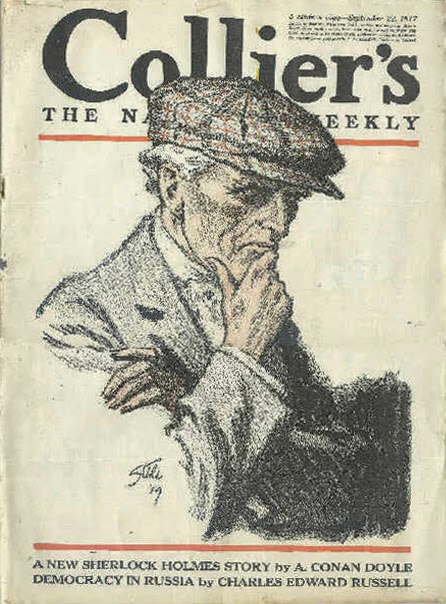
"His Last Bow" chronicles a fiction set in what Doyle's readers knew all too well by September 1917 had, in real life, proved "the most terrible August in the history of the world". As they read it, they knew not when the struggle would end or who would win. After three years, war and only war was the single all-consuming reality.

Doyle reflects and respects this by muting the comfortable and familiar until the final intimate, lyrical exchange where fictional words spoken in 1914 are charged with the actual sober defiance of '17. 

That real future is effectively intertwined with four years of fiction within the story's August 1914 hour of action and these resonances render the defeat of Von Bork symbolically momentous.
Von Bork, captive.  Illus A Gilbert, The Strand 1917.

So, as we follow the sequence of fictional episodes, present and past, it is within the known context of real and apocalyptic events. And the author's motive is as simple as his story - reassurance, in pursuit of which every element is designed to illustrate the complacency of the enemy and the superior ingenuity of John Bull. 

That pattern is there in the construction of what occurs within an hour from 9 pm on August 2nd 1914.

 The first half hour belongs to Von Bork and Von Herling. Doyle gives them their (premature) self-congratulatory taste of victory. "The good Altamont" is understood (before his arrival) to be admired and trusted implicitly. The reader is at this stage no wiser than the Germans and (with a Sherlockian delight in the dramatic), the author delays Holmes's coup de theatre to allow the detective private amusement in Altamont's  baiting of Von Bork about his exposed agents.

To the victors however goes the second half hour, crowned with a nostalgic tableau of the way things were.
Bruce & Rathbone "Sherlock Holmes and the Voice of Terror" (Universal) 1942.

From the conversations in both phases of the story's present the reader is guided to a similar understanding of the past. 

Initially, we believe, with Von Bork, that he has inveigled himself into English society since 1910 without suspicion and amassed a treasure trove of secrets that will soon be in Berlin. The work of four years is all but finished; he awaits only the latest set of naval signal codes to be delivered that night by his most resourceful spy. He has already sent his wife and large household to Flushing in Holland, leaving only himself and one servant, old Martha, who "might almost (harmlessly) personify Britannia"

Doyle proceeds comprehensively to undercut every apparent enemy achievement. If the betrayal and capture of Steiner surprises Von Bork, it pales to insignificance once all is revealed. The ironies cut as deep into the German as they will delight his enemies.

Sailing under the false colours of "a good old sport" is exposed both as a paper-thin disguise and no true reflection of the blackguard within as Doyle presents the newly revealed Holmes with all the courtesies of a real sportsman and gentleman.

Did he but know it, Von Bork was a dead duck in the water from the moment Altamont surfaced in 1912. Undetected as submarines, Holmes and his female confederate disguised as old Martha penetrate organization and household. Networks of communication and agents are fatally, secretly compromised. No wonder then at the German master spy's incandescent curse.
Von Bork humiliated. Illus A Gilbert, The Strand 1917.
 "Curse you, you double traitor!' cried the German, straining against his bonds and glaring murder from his furious eyes."

As Sherlock Holmes notes, following this "furious stream of German invective", the German's unmusical outburst is an "old sweet song" often heard in days gone by. It's a swansong: Von Bork has taken His Last Bow.

Epilogue. 

And so had "Altamont". So too, did Conan Doyle intend the collection's eponymous title to signal the last of the stories.

In this centenary year we are perhaps best placed to be thankful the only last bow in real life was that of the Kaiser. Cameth the hour, cameth the men.

This one.
 This one.


And Millions Like Us.

© Ray Wilcockson (2014) All rights Reserved

Further Reading: 

"His Last Bow" by Sir Arthur Conan Doyle may be read on line HERE .

My short story "Good Night, Mr. Sherlock Holmes" imagines the events of the day after "His Last Bow" and may be read HERE .


Thursday, July 17, 2014

Form, Intent, Content and Language - The Barrowford Letter.

Some brief comments, supplementary to this post by GoverNancy writing on TES Connect about Barrowford Primary School's letter to pupils. GoverNancy reproduces the letter.

What follows records my response when I read the letter via Twitter prior to the appearance of online commentary. It's the approach I take to all written matter.

What am I reading?

Form is an authorial choice, a signpost to how I am invited to read and with what evaluative criteria.
This is in letter form. I am not addressed. A headteacher is addressing an 11 year old. However, it is standardized to include all relevant recipients and hence in the general class, formal letter, enclosing, as it does, that most formal of communications: exam (here SATS) results. I would in normal circumstances never have read this letter. A parent published it and it has subsequently been widely read, by far more people than those to whom it is specifically written.

Why was this letter written?

Authorial intent is patently to write something as an introductory courtesy which may accompany and offer context for educational information of the highest significance to writer and reader. The alternative was to forward the results alone. I reflect that the letter did not have to be written, that the writer has much else to do, that it is close to year's end, that the students addressed are leaving and hence, the writer will rightly, humanly feel all that implies.

I find myself describing an altruistic impulse which I am not surprised to find in a teacher.

What does the letter say?

I note that the central communication, eagerly and anxiously awaited by pupil and parent or guardian, is the all-important exam result. Given that unmistakable presence, I hardly expect the letter to state the obvious. It would render it superfluous. The introductory paragraph is enough to confirm what all involved are acutely aware of: SATS results matter a lot.

The bulk of the letter is expressly designed to affirm this is a school that values and (here) celebrates much much more than that which SATS results report on. This affirmation is not merely a personal (and certainly neither a prejudiced nor political) passage - the head teacher is echoing the National Curriculum for KS1 and KS2, as is her legal duty.Specifically, she takes this supremely appropriate moment to remind all concerned that the school curriculum comprises more than learning. Section 2 HERE formally expresses that which the letter details in a language more appropriate to a different context and audience.

I make a mental note that the final paragraph (of course) returns to the matter of SATS and that "there are many ways to be smart" has no pretension to be an educational theory. She's right - children are praised for a "smart" appearance and SATS doesn't report on your prowess with the violin.

Is the language appropriate?

"Smart" is a word in common (as opposed to academic) use, closer to "smartypants" than anything else. It suits the audience and broader education theme. Clearly, this teacher is going for language that's informal and accessible to children (parents will read and, from the flurry of positive public responses, pick up on this head's intended implication - we understand your child and they understand us, see?).

I recognized immediately that I'd read the central paragraph via a link months before. Notions of plagiarism are just not relevant in this context. I thought of the head, finding a moment to try to support her pupils at a crucial time the best way she could muster. Well, this passage, in content, language and spirit does the job.

End of.