Friday, June 29, 2012

The Great Hiatus (1) - Stranded Holmesless.

The Classic Holmes by  Paget, 1891.


Readers of the December, 1893, issue of The Strand Magazine were abandoned at the close of The Final Problem, left perhaps to recall nostalgically that classic pose Sidney Paget had drawn for The Man With The Twisted Lip but two years before - an image of the now dead detective in apotheosis, clad in his trademark dressing gown, musing perhaps prophetically on the congenial, if fatal, conclusion to his career.

Conan Doyle's last story had of course been handed to the editor, H. Greenhough Smith, months earlier. On April 6, having returned to Norwood from a visit to Switzerland (and Reichenbach) he sat in his study, with a head cold, vaguely reading Pride and Prejudice as painters erected ladders outside. Abandoning the Austen, he wrote to the Ma'am:

"All is very well down here. I am in the middle of the last Holmes story after which the gentleman vanishes, never to return! I am weary of his name."

The day before Robert Louis Stevenson had written from Samoa, ironically to compliment Doyle on his creation. Doyle replied:

"I trust that I may never write a word about him again."

(Of course, he would: the story would be revised after his visit to the Reichenbach Falls that Summer.)

From the point of view of The Strand, Doyle's decision was alarming. Holmes and his creator had been with the magazine since its inception in July, 1891 and, thus far, the partnership had rewarded both sides handsomely.
H. Greenhough Smth.

Doyle's motivation is revealed in his 1924 Memories and Adventures:
"A number of monthly magazines were coming out at that time, notable among which was the Strand, under the very capable editorship of Greenhough Smith. Considering these various journals with their disconnected stories it had struck me that a single character running through a series, if it only engaged the attention of the reader, would bind that reader to that particular magazine ... Looking around for my central character, I felt that Sherlock Holmes, who I had already handled in two little books, would easily lend himself to a succession of short stories".

For A Scandal in Bohemia and the five succeeding stories (written between April and August, 1891) Doyle was paid an average of £35 each, less agent's fee. He had not intended to write more.

By October, seeing the popularity of Sherlock Holmes and his positive impact on circulation, The Strand was in a flat panic for more so that the series might continue into 1892, uninterrupted. He writes to the Ma'am on 14 October:

"The Strand are simply imploring me to continue Holmes...I will write by this post to say that if they offer me £50 each irrespective of length , I may be induced to reconsider my refusal. Seems rather high-handed, does it not?"

Not to The Strand who replied by return of post and asked when they could have the new stories.

If the magazine felt Holmes had thus been secured for the long-term, Doyle had no such intention.By 11 November, having written five of the second set of six, he confided to the Ma'am:

"I think of slaying Holmes in the last and winding him up for good and all. He takes my mind from better things."

"You won't! You can't! You mustn't!" she scolded.

And, of course, Doyle proceeded to write The Copper Beeches based on an idea first suggested by the Ma'am.

February, 1892: "They have been bothering me for more Sherlock Holmes tales. Under pressure I offered to do a dozen for a thousand pounds, but I sincerely hope they won't accept it now."

By Summer he had completed only the first three Memoirs. Silver Blaze headed the second series of twelve adventures in December and (with The Naval Treaty divided between October and November) exactly a year later, Holmes's death was sprung on an unsuspecting public. 

The Strand lost 20,000 subscriptions.

Seven and a half years (or 91 issues) issues later, 30,000 new subscriptions were taken out as a result of the serialization of The Hound of the Baskervilles.

In 1903, ten years to the month since Doyle wrote The Final Problem, he completed The Empty House, acknowledging his debt to Jean for the idea. In early Spring, an offer too tempting to refuse had come from America:- $5000 for each of 6 stories (or as many as he was prepared to write). And George Newnes, owner of The Strand bought the English rights with a similarly lavish advance.

For Holmes what has been termed "The Great Hiatus" had ended. For The Strand, it meant instant release from the pressure of finding stories that might appeal to fill each monthly issue.

An examination of the contents of the magazine over the 91 'Holmesless' issues shows a continuing reliance on the name of Conan Doyle and illustrator, Sidney Paget.

STRAND MAGAZINE CONTENTS 1891-1930

 Brigadier Gerard, Rodney Stone,Tragedy of the Korosko, non-Canonical short stories and non-fictional articles bridge the hiatus...but the subscription figures quoted speak for themselves. These were no substitute for  what today we should term the "cash cow" that is Sherlock Holmes.

Nor were contributions from other authors enough to quell the decade-long clamour to bring back Holmes. Hornung and Wells (including The First Men in the Moon) join The Strand stable to little appreciable effect.

Greatest sympathy must surely go to those writers who attempted directly to fill the yawning gap left in detective fiction. Pity especially the best of Doyle's imitators during the fallow years - Arthur Morrison, who had the unenviable honour of launching his new detective, Martin Hewitt, but three months after The Final Problem.

Morrison's detective was ordinary, short, good-tempered and got on well with the police. His novel characteristic was to operate in a grey area where he sometimes bordered on the criminal himself. Three volumes of Hewitt stories were published. The first (The Lenton Croft Robberies) may be read on-line with Sidney Paget's illustrations.

 : MARTIN HEWITT STORIES


It must have been a strange experience indeed for the illustrator to turn his imagination from Holmes to Hewitt so abruptly and one would dearly love to know just what were his private thoughts.

The works of Arthur Morrison are available to read on line:

WOKKS of ARTHUR MORRISON

His best work is the novel A Child of the Jago, a graphic account of life in the East End, largely based on the true story of Old Nichol Street Rookery.
As his portrait above perhaps shows, Morrison was of a shy, reticent nature (the opposite of Conan Doyle). In 1914, he retired  from writing into 30 years of obscurity, having sold his astounding art collection of Japanese prints for £4000 to the British Museum.

Though he is now remembered for his collection and two-volume work, The Painters of Japan, he failed, even in dying, to imitate Conan Doyle with any success - for it is said that when he died in 1945 the World was more astonished to learn that he was still living than that he was dead.

Perhaps Arthur Morrison was destined just to keep a candle burning in the dead of night pending a new Sherlockian Dawn.


Postscript:
                    The BBC produced an excellent collection of The Rivals of Sherlock Holmes from 1971. All episodes of Series 1 may be viewed on Youtube. Here is a link to one of the Martin Hewitt stories dramatised; the others may easily be found once you are at this linkpage THE RIVALS OF SHERLOCK HOLMES


"It may be that you are not yourself luminous, but that you are a conductor of light".  (Sherlock Holmes, The Hound of the Baskervilles).


Saturday, June 23, 2012

The "REICHENBACH" CHALLENGE CUP.


Pre-Match Report by Mr. Horace Harker.

Exclusive!

From our Special Correspondent, Mr. Horace Harker, of the Central Press Syndicate.

BODMIN June 24.


In the early hours of this morning  I, Horace Harker, was summoned from my slumbers by a telegram. Your correspondent, as assiduous as ever in the pursuit of his Profession , forthwith dressed, summoned a cab and presented himself at the door of 221b Baker Street.
What transpired there has, at the express invitation of the Great Detective, Mr. Sherlock Holmes,brought me hither from my little Kensington backwater of 131, Pitt Street to the very centre of the Great Grimpen Mire,  on the Dartmoor, in the County of Devonshire.

Kind Reader! Even your correspondent was aghast, struck dumb, rendered speechless and in need of a restorative brandy by the spectacle that greeted his world-weary eyes.
For there, impossibly, at the end of a freshly dug, rough-hewn highway across the Moor stood a veritable Amphitheatre, a Colossal Stadium, a Circus Maximus of which your very builders of the Ancient World would have been proud.

 As if blithely dismissive of that treacherous ground, “The Chasm” (for that is its appellation, nay the agnomen of this singular edifice) stands immovably  rooted firmly to the deepest subterranean bedrock upon Titanic piles driven by the most Gargantuan engines our Empire may afford.
This, dear Reader, I , Horace Harker, humble journeyman , was now given to understand had been expressly constructed by order of Her Majesty’s Government to house what promises to be the Match of the Century.
Fear not! Harker will be there to witness and report on your behalf every twist and turn, every kick, foul, penalty and goal, every morsel of the 90 minute struggle between ( I do not exaggerate!) True Leviathans  out to win The Reichenbach Challenge Trophy!
But a few brief hours from now, as the sun goes down, gigantic  generators  of proportions never attempted before are set to whir into life flooding the darkening arena with an Electrical Illumination to rival Sol Himself!
THEN! Oh, faithful Reader, shall two teams take the field, each in its own inclination La Crème de la Crème.


For the Empire! For Our Beloved Queen Victoria! Playing for all that is civilised, lawful and of good report: BRITANNIA, trained by Mr. Mycroft (‘Diogenes’) Holmes.  


For the Underworld! For the Napoleon of Crime! Playing on behalf of all that is nefarious, evil  and of dastardly report: TENEBRAE, trained  by James (“The Professor”) Moriarty.

As I write this pre-match report, M. Alphonse Bertillon of The Prefecture of Police in Paris, is completing essential Anthropometric tests on all team members to confirm identities. Referee. James Mcfarland of the American Pinkerton Detective Agency is giving last minute guidance to his assistants.
Harker Readers!  Humbly proud am I to represent you at pitch-side as witness to this Epic Encounter. I dare say, in the corridors of Westminster, in every Royal Palace, at the remotest corners of our far-flung Empire, from Kandahar to Winnipeg, from Mafeking to Adelaide (Ay! Even upon the High Plateau of Tibet!) there kneel  in prayer all who  carry the torch of Virtue in their hearts, beseeching The Almighty to take the field in the red and gold battalions of BRITANNIA.!
Defeat is unthinkable. When our stalwarts engage the black-suited horde of  TENEBRAE no quarter will be given or expected.  The Game’s Afoot!
This is Horace Harker of the Central Press Syndicate – your Man On The Spot.
STOP PRESS!!
I have just been handed a copy of the Team Sheet and starting Line-up!

                                           BRITANNIA
                                             Hudson
Bradstreet     Watson             Lestrade              Hopkins

Trevor         Stamford        Baskerville            Wiggins

                              Holmes (S)           Crocker

                                         TENEBRAE
                                               Beppo
Stockdale        Roylott                   Moran          Dixie

Stark                Slaney                Giorgiano      Oberstein

                          Von Bork               Clay

On the Bench:
Britannia Bench
Athelney-Jones (Gk)
Lanner (Gk)
Billy (Supersub)
Gregson
Baynes
Musgrave
Cadogan West
Johnson
McCarthy
Porlock
Adler     (unavailable - c0mpassionate leave).

Tenebrae Bench.
Rucastle (Gk)
Brunton (Gk)
Milverton (supersub)
Silvius
Bohemia
Culverton Smith
Oldacre
Von Gruner
Venucci
Straker
Tonga (failed anthropometric test)
Garrideb , Stapleton & Merton (life-time bans).

*In the event there is no result after extra time this "Final Problem" will be resolved by "Sudden Death".

H. HARKER.

                                     
-----------------------------------------------------------------


YOUR BLOGGER, DEAR READER, SAYS:


I had great fun writing this light-hearted post. You will, naturally, quarrel with my team choices! But that's football!

Speaking of which....
                               Italy may have won in 2012
but Pietro Venucci would not score a penalty against Mrs. Hudson!


Postscript: "Playing The Game" is something new for me. I am a strong advocate of more literary analysis of Doyle's original stories as artistic constructs. See my previous posts on SCAND & EMPT and watch for my forthcoming "Moriarty- the Final Problem".
So the genesis of 'Reichenbach Challenge Cup' and its critical value fascinate me.
Euro2012 and current musing on Moriarty blended in my mind like the images of a metaphor and resulted in my creating complete lists of virtuous and vicious characters as player pools.
Such a process involves a lot of refresh reading and assessment.

4 4 2 for both team line-ups seemed the most elegant pattern.

 Names for the teams went through a long process starting with 'Good City' v 'Evil United' (Bunyanesque) evolving through eg: 'Illuminati', 'Underworld'....I settled on 'Tenebrae' (the shadows) as a delicious word that also sounded like a mid-European football team. 'Britannia' came last as a better all-encompassing nomination than 'Queen's'.

Key characters had to figure but in character. Hence, Moriarty and Mycroft as schemer managers came first.

Mrs. Hudson was first onto my team sheet, followed by Sherlock Holmes and John Watson.

Crocker (whom I see as Jack London) and Lestrade seemed strong complements to Holmes and Watson in forward attack and at the centre of defence.

Beppo leapt up next as the ideal comic opposite of Mrs. Hudson to keep goal. 

Other particularly delightful choices (for me) were: Irene Adler (who would have partnered Holmes but, finally, I realised she was more faithfully effective as 'unavailable, on compassionate leave' (to marry). The 2 supersubs. And I remember wanting to include Tonga somehow - but he'd be too farcical on the field and when the notion of having Bertillon check identities came to me, I realised the comedy of Tonga as disqualified by reason of failed test. 

Having listed Bertillon and the neutral Pinkerton agents as match officials, I cast about for a match reporter and realised how grateful Horace Harker would be to be offered exclusive rights by Holmes himself after missing his scoop in SIXN.

The last idea to come to me (after completing the team sheets) was a development of naming Harker  coupled with a sense the post would benefit from pictures.

'Twas here the fun (for me) really started - I heard Harker's voice clearly and wrote as it were to his dictation, allowing him to promote himself ad extremis as well as write with respectable literacy. I suspect we shall hear from him again, as I sense a rich vein not yet worked out.

So> playing the game - yes. But along with it accrued the benefits of renewed detailed knowledge of Doyle's originals and a singular intimacy with his creations. 
Ray WIlcockson 25. June, 2012.


Thursday, June 21, 2012

Robert Louis Stevenson's Letters to Doyle 1893-4.

R.L.S.by Sargent, 1887.


Sir Arthur Conan Doyle and Robert Louis Stevenson -

Ships in the night. 


To read the last letters of R.L.S is to regret the premature death of a great writer and an opportunity lost for a meeting with another great literary son of Edinburgh. Both Doyle and Stevenson knew Joseph Bell; both declared their debt to each other's work and shared friends in common. But they would never meet.

As the letters below indicate, definite plans were made for Doyle to extend his September 1894 tour of America to take in Samoa, which Stevenson had made his permanent home since 1890. 
The best laid plans of mice and men...Stevenson died on the 3rd of December. Forty chiefs cleared a path overnight and carried his body to its resting place on Mount Vaea.


I leave the letters to speak for themselves.

Letter: TO A. CONAN DOYLE

VAILIMA, APIA, SAMOA, APRIL 5TH, 1893.
DEAR SIR, - You have taken many occasions to make yourself very agreeable to me, for which I might in decency have thanked you earlier. It is now my turn; and I hope you will allow me to offer you my compliments on your very ingenious and very interesting adventures of Sherlock Holmes. That is the class of literature that I like when I have the toothache. As a matter of fact, it was a pleurisy I was enjoying when I took the volume up; and it will interest you as a medical man to know that the cure was for the moment effectual. Only the one thing troubles me: can this be my old friend Joe Bell? - I am, yours very truly,
ROBERT LOUIS STEVENSON.
P.S. - And lo, here is your address supplied me here in Samoa! But do not take mine, O frolic fellow Spookist, from the same source; mine is wrong.
R. L. S.

Letter: TO A. CONAN DOYLE

VAILIMA, JULY 12, 1893.
MY DEAR DR. CONAN DOYLE, - The WHITE COMPANY has not yet turned up; but when it does - which I suppose will be next mail - you shall hear news of me. I have a great talent for compliment, accompanied by a hateful, even a diabolic frankness.
Delighted to hear I have a chance of seeing you and Mrs. Doyle; Mrs. Stevenson bids me say (what is too true) that our rations are often spare. Are you Great Eaters? Please reply.
As to ways and means, here is what you will have to do. Leave San Francisco by the down mail, get off at Samoa, and twelve days or a fortnight later, you can continue your journey to Auckland per Upolu, which will give you a look at Tonga and possibly Fiji by the way. Make this a FIRST PART OF YOUR PLANS. A fortnight, even of Vailima diet, could kill nobody.
We are in the midst of war here; rather a nasty business, with the head-taking; and there seem signs of other trouble. But I believe you need make no change in your design to visit us. All should be well over; and if it were not, why! you need not leave the steamer. - Yours very truly,
ROBERT LOUIS STEVENSON.

Letter: TO A. CONAN DOYLE

VAILIMA, AUGUST 23RD, 1893.
MY DEAR DR. CONAN DOYLE, - I am reposing after a somewhat severe experience upon which I think it my duty to report to you. Immediately after dinner this evening it occurred to me to re- narrate to my native overseer Simele your story of THE ENGINEER'S THUMB. And, sir, I have done it. It was necessary, I need hardly say, to go somewhat farther afield than you have done. To explain (for instance) what a railway is, what a steam hammer, what a coach and horse, what coining, what a criminal, and what the police. I pass over other and no less necessary explanations. But I did actually succeed; and if you could have seen the drawn, anxious features and the bright, feverish eyes of Simele, you would have (for the moment at least) tasted glory. You might perhaps think that, were you to come to Samoa, you might be introduced as the Author of THE ENGINEER'S THUMB. Disabuse yourself. They do not know what it is to make up a story. THE ENGINEER'S THUMB (God forgive me) was narrated as a piece of actual and factual history. Nay, and more, I who write to you have had the indiscretion to perpetrate a trifling piece of fiction entitled THE BOTTLE IMP. Parties who come up to visit my unpretentious mansion, after having admired the ceilings by Vanderputty and the tapestry by Gobbling, manifest towards the end a certain uneasiness which proves them to be fellows of an infinite delicacy. They may be seen to shrug a brown shoulder, to roll up a speaking eye, and at last secret bursts from them: 'Where is the bottle?' Alas, my friends (I feel tempted to say), you will find it by the Engineer's Thumb! Talofa- soifuia.
Oa'u, O lau no moni, O Tusitala.
More commonly known as,
R. L. STEVENSON.
Have read the REFUGEES; Conde and old P. Murat very good; Louis XIV. and Louvois with the letter bag very rich. You have reached a trifle wide perhaps; too MANY celebrities? Though I was delighted to re-encounter my old friend Du Chaylu. Old Murat is perhaps your high water mark; 'tis excellently human, cheerful and real. Do it again. Madame de Maintenon struck me as quite good. Have you any document for the decapitation? It sounds steepish. The devil of all that first part is that you see old Dumas; yet your Louis XIV. is DISTINCTLY GOOD. I am much interested with this book, which fulfils a good deal, and promises more. Question: How far a Historical Novel should be wholly episodic? I incline to that view, with trembling. I shake hands with you on old Murat.
R. L. S.

Letter: TO A. CONAN DOYLE

VAILIMA, SAMOA, SEPTEMBER 9, 1894.
MY DEAR CONAN DOYLE, - If you found anything to entertain you in my TREASURE ISLAND article, it may amuse you to know that you owe it entirely to yourself. YOUR 'First Book' was by some accident read aloud one night in my Baronial 'All. I was consumedly amused by it, so was the whole family, and we proceeded to hunt up back IDLERS and read the whole series. It is a rattling good series, even people whom you would not expect came in quite the proper tone - Miss Braddon, for instance, who was really one of the best where all are good - or all but one! ... In short, I fell in love with 'The First Book' series, and determined that it should be all our first books, and that I could not hold back where the white plume of Conan Doyle waved gallantly in the front. I hope they will republish them, though it's a grievous thought to me that that effigy in the German cap - likewise the other effigy of the noisome old man with the long hair, telling indelicate stories to a couple of deformed negresses in a rancid shanty full of wreckage - should be perpetuated. I may seem to speak in pleasantry - it is only a seeming - that German cap, sir, would be found, when I come to die, imprinted on my heart. Enough - my heart is too full. Adieu. - Yours very truly,
ROBERT LOUIS STEVENSON


To the letter of 5 April, 1893, Conan Doyle responded:

I'm so glad Sherlock Holmes helped to pass an hour for you. He's a bastard between Joe Bell [a famous Edinburgh surgeon] and Poe's Monsieur Dupin (much diluted). I trust that I may never write a word about him again. I had rather that you knew me by my White Company. I'm sending it on the chance that you have not seen it".

R.L.S. at the Royal Laua in 1889.


Sunday, June 3, 2012

Doyle's Waterloo - Special (1897) Jubilee Post.

"I saw him" (Richard Sharpe).


Sharpe may have had his Waterloo but so did Conan Doyle.

This Jubilee post is about a one-act play starring Sir Henry Irving, written by Doyle which played a significant role in the Diamond Jubilee celebrations for Queen Victoria in 1897.

   In March 1892, a play arrived on the desk of the great Victorian actor, Henry Irving. Entitled "A Straggler of '15", it was a patriotic, sentimental piece, recording the reminiscences of an old surviving soldier of the Battle of Waterloo. He gave it to Bram Stoker, manager of the Lyceum Theatre, to read - Stoker recalls their response in his biography:

"I think this," I said '"that play is never going to leave the Lyceum. You must own it- at any price. It is made for you."

"So I think too", he said heartily.You had better write to the author today and ask him what cheque we are to send..."

"Who is the author?"

"Conan Doyle".

Irving bought the play's rights, changing the name to "A Story of Waterloo"- then shortening it to "Waterloo".

Striking a chord with his imperial audience, the play was an immediate success from its first performance on Sept 21, 1894 at the Princess Theatre, Bristol. The part of Corporal Brewster was destined to be Irving's most popular and final great role.

Irving as Brewster by Harry Furniss 1893.
Stoker records the events of 1897:

"...when representatives of the Indian and colonial troops were gathered in London for the 'Diamond' Jubilee of Queen Victoria, Irving gave a special performance for them. The event was a formal one for it was given by Royal consent...Some 2000 troops... were massed at Chelsea Barracks...They marched to the Lyceum, the public cheering them all the way. They represented every colour and ethnological variety of the human race from coal black through yellow and brown to the light type of Anglo-Saxon...In the boxes and stalls sat the Indian Princes and the Colonial Premiers...The house was crammed from wall to wall, from floor to floor, the bill was Waterloo and The Bells.No such audience could have been had for this military piece. It sounded the note of the unity of the Empire; all were already tuned to it.  The scene was indescribable, it was a veritable ecstacy of loyal passion...".


Its authorship by the great advocate of empire...place Doyle within an Imperial nexus. That same year as if to undercut such imperial confidence, Bram Stoker's Dracula was published.

But that's another story.

Doyle's Waterloo may conveniently be read on line. Click this link to open the play in a new window Doyle's Waterloo

I can think of no better close to this celebratory post than a piece of music made famous by Sean Bean's Richard Sharpe TV Series - I reckon Sharpe would be one of Conan Doyle's ideal knightly heroes.

Enjoy this fabulous, heartfelt rendition of Over The Hills And Far Away and think of the swelling pride of Irving and Doyle on a halcyon day in 1897. John Tams (of course!) sings
Song for Doyle's Waterloo

Sir Henry Irving in Waterloo.


Tuesday, May 29, 2012

"Off to Violin Land" - A Stradivarius for Undershaw.

Antonius Stradivarius.


The Creator.

The Violin.

The Players.


This is the story of one violin.

Antonio Stradivari probably began producing his first decent musical instruments in 1660 at the age of 16. He would continue to do so until his death in 1737.

"Antonio Stradivari" by |Edgar Bundy, 1893.

The years 1700 t0 1720 are often termed "the golden period", and instruments dating from these years are considered his finest work.

Stradivari created what is now known as Number 287, in 1709. It is famed for its special tonal merit - and association with Wilma Norman-Neruda   and Sherlock Holmes.
'The Ernst' 287 1709 Stradivarius.


"In an earlier chapter, I referred to the first Straduarius violin that had ever come before me, and which had been shewn me by Ernst on the occasion of his first visit to Leeds early in the 'fifties. In order to shew how the lives of these famous fiddles may be traced, I give the following interesting account. Approaching one hundred years ago, two very fine specimens of Straduarius workmanship came into the possession of Mr. A. Fountaine, of Narford Hall, in Sussex. These two violins he kept in a double case, where they rested, side by side, for many years. Mr. Fountaine, a great enthusiast, was in the habit of inviting musical house-parties from London for the week-ends.

Among those who were most frequently invited was Ernst, and, as a great privilege, he was permitted to lead the quartet party or to play his solo contributions on one of these superb fiddles the one usually designated by Mr. Fountaine as his
"second best ;" the other instrument never being permitted to be used for playing purposes, but being lifted from the case merely for admiring glances. One memorable Sunday, Ernst played so exquisitely on the "Strad." lent him by his host, that Mr. Fountaine said he must use it regularly as his solo instrument, and straightway made the artist a gift of it. This was the violin shewn me by Ernst in 1852, and which he used till the day of his death. After passing through several hands, it was the one selected, twenty years later, by Madame Norman-Neruda, who was requiring such an instrument for her own concert performances. "
Some Early Musical Recollections of G. Haddock, George Haddock, Schott & Co., London, 1906
  
Lady Halle was the wife of Sir Charles Halle who founded his eponymous orchestra. At the time of A Study in Scarlet when Sherlock Holmes goes to her concert, she was known by her first husband's name, Neruda. She would own and play The Ernst 287 until 1911 and this is the very instrument Holmes would have so enjoyed.
The Ernst.


Holmes comments: “I want to go to Hallé’s concert to hear Norman Neruda this afternoon. . . . Her attack and bowing are splendid. What’s that little thing of Chopin’s she plays so magnificently: Tra-la-la-lara-lira lay.” Watson then adds in his own voice, “Leaning back in the cab, this amateur bloodhound caroled away like a lark while I meditated on the many-sidedness of the human mind."

The Ernst provenance has been painstakingly traced and details may be read here .

I can find no recording of Wilma Norman-Neruda BUT for your pleasure AND as today's #MusicofUndershaw selection I have this link to an all-too-brief, tantalising 22 seconds of beautiful music played by Ruggiero Ricci: Here is the 1709 Ernst Stradivarius Number 287 - the very instrument Sherlock Holmes heard in the talented hands of Wilma Norman-Neruda The Glory of Cremona .

Wilma Neruda.

Saturday, May 26, 2012

"At the St. James's Hall" - 26/5/12 - MusicforUndershaw


"All  the afternoon he sat in the stalls wrapped in the most perfect happiness..."  
   ("The Red-Headed League".)

On the afternoon of Saturday, October 11th, 1890, John Clay and his confederate, Archie, were burrowing relentlessly from Jabez Wilson's cellar toward a vault beneath the City and Suburban Bank. Meanwhile, Sherlock Holmes and Dr. Watson relaxed at the Saturday "pop" concert at St. James's Hall, Piccadilly, listening to the virtuoso Spanish violinist, Pablo Sarasate.


Opened in 1858, to the design of Owen Jones who decorated the interior of The Crystal Palace, St. James's Hall had frontages on Regent St. and Piccadilly. Built jointly by music publishers Chappell & Co. and Cramer & Co., it was London's foremost concert venue until demolition in 1905.


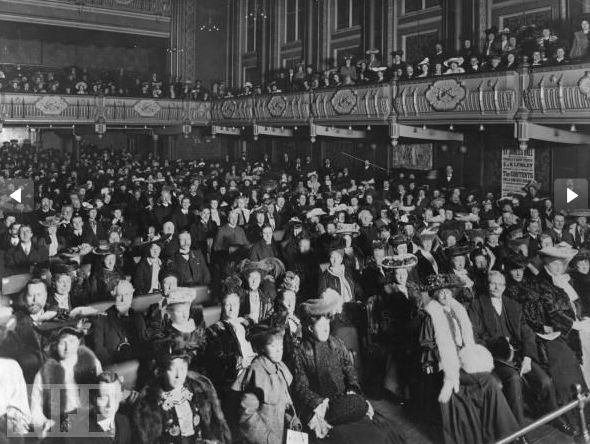
Last concert 1905.


With a capacity of 2000 people in the Alhambra-style main hall, which housed the Monday & Saturday"Pops" classical concerts, the Hall had smaller performance rooms and a restaurant. One of these side halls was the permanent home of the Christy Minstrels (later the Moore & Burgess Minstrels).

If George Bernard Shaw is anything to go by, the minstrel troupe's playing could often be heard in the main hall, making for a  surreal musical experience. In January, 1890:

"At the Hallé orchestral concert... I was inhumanly tormented by a quadrille band which the proprietors of St James's Hall (who really ought to be examined by two doctors) had stationed within earshot of the concert-hall. The heavy tum-tum of the basses throbbed obscurely against the rhythms of Spohr and Berlioz all the evening, like a toothache through a troubled dream; and occasionally, during a pianissimo, or in one of Lady Hallé's eloquent pauses, the cornet would burst into vulgar melody in a remote key, and set us all flinching, squirming, shuddering, and grimacing hideously"
That Lady Halle was, of course Wilma Norman-Neruda, one of Holmes's favourite violinists. One assumes there were times Holmes quietly cursed the "wild strains of brazen minstrelcy" rising from the room below.

Interior St. James/s Hall.
The violinist, Rachel Barton Pine, gives an illuminating account of Pablo Sarasate's career in the 1890's here .

I have three Sarasate pieces to listen to, this day in 2012. 

1. Rachel Barton Pine playing his "Airs Ecossais" first performed by Sarasate himself in the St. James's Hall, May 28, 1894. As this is a month after the return of Sherlock Holmes, as recounted in The Empty House I like to think Holmes managed to catch the performance: Airs Ecossais.

2. Amazingly, recordings exist of Sarasate playing his own works in 1904. Listen to the man and the instrument Holmes loved, playing Zigeunerweisen: Sarasate in 1904.

3. Finally, my Sarasate Piece-of-the-Day, dedicated to the #SaveUndershaw Campaign.
Watch and listen to the fabulously talented Henryk Szeryng play Sarasate's Zapateado: MusicofUndershaw .

Jeremy Brett muses on the MusicofUndershaw.

No better way to end this post than to return to St. James's Hall to watch Brett's Holmes enjoying virtuoso violinist Bruce Dukov's recreation of Sarasate playing the Bach E major Prelude: Off to Violinland!


:
  

Friday, May 25, 2012

The Power of Music - A Jubilee Serenade for Undershaw.

Conan Doyle outside Undershaw.


"Hand me over my violin and let us try to forget for half an hour the... miserable ways of our fellow-men".
                                                                                      (Holmes: "The Five Orange Pips").

May 25, 2012 - and what to do now the case for Undershaw has been presented and thousands worldwide await the High Court decision?

WELL...I'm going to take a leaf out of Conan Doyle's book and put my faith in the power of music by tweeting and blogging daily pieces of music associated with Sherlock Holmes, Conan Doyle and the Britain of Victoria's Diamond Jubilee of 1897, the very year in which Conan Doyle took up residence in his beloved fairyland home.

AND...I send these musical ambassadors through the ether of our world wide web to work their diplomatic magic on the owners and arbitrators of a future for Undershaw. 

FOR..."Do you remember what Darwin says about music? He claims that the power of producing and appreciating it existed among the human race long before the power of speech was arrived at. Perhaps that is why we are so subtly influenced by it. There are vague memories in our souls of those misty centuries when the world was in its childhood."
                                            (Holmes: "A Study in Scarlet".)


At Undershaw it is always 
1897.


A home - no matter how humble - is never just bricks and mortar. The house Doyle built may not be of outstanding architectural significance, but that's an irrelevance: old spirits yet inhabit that Empty House.

To borrow from Vincent Starrett: "Shall (he) not always live in (Undershaw). (Is he) not there instant, as one writes...So (he) still live(s) for all that love (him) well in a romantic chamber of the heart, in a nostalgic country of the mind: where it is always 189(7)".

This Jubilee year of 2012, the nation is spending much time, effort and money on...nostalgia. And this should be a reminder, a wake-up call to those who may so easily have forgotten the crucial importance of those "misty centuries" that make us more than mere flesh and bone.

This brief Blog is my introduction to a week - or month - of music associated with Sherlock Holmes, Arthur Conan Doyle and the 1897 Jubilee - and I shall tweet or blog a new piece daily until the day of judgment, believing, with William Congreve that:
"Music hath charms to soothe a savage breast, to soften rocks, or bend a knotted oak."


Watch and listen to 90 year old Jack Leroy Tueller, movingly relate his experience of the power of music during World War Two. Please click this link for Youtube video:
The Power of Music  

We are, in 2012, closer than we think to 1897. I was privileged to know my father's mother many years before she died: she, who had been born in 1886 and was herself but one person away from the previous century. Our modern cinema, television and computer screens carry new-minted images of Doyle's great detective and account for much of the current world-wide protest concerning Undershaw. But those images ( and those soon to be broadcast of Elizabeth's Jubilee) are only possible because of Victorian cinema pioneers.

 In 1897, R.W. Paul produced the following state-of-the-art movie of Queen Victoria's Diamond Jubilee Procession: Please click this link for video from Youtube:
THE 1897 JUBILEE PROCESSION.

MUSIC FOR UNDERSHAW - 25 MAY, 2012.


"That he could play pieces, and difficult pieces, I knew well, because at my request he has played me some of Mendelssohn’s Lieder and other favourites."
                                        (Dr. John Watson: "A Study in Scarlet").

What more fitting for my first selection than one of Mendelssohn's "Lieder ohne Worte" - the phrase translates as "Song without Words" (we have heard all the words for Conan Doyle's home - now let the music of Undershaw be heard!).

Here is Lied ohne Worte No. 1, Opus 30 in Liszt's arrangement for violin and piano: please click the link for Youtube video:

The Mendelssohn, Watson!

I shall tweet each daily selection. If you wish to hear the Music of Undershaw each day, please follow me on Twitter

@raywilcockson

#MusicofUndershaw

Facebook: http://www.facebook.com/#!/ray.wilcockson

Or my Markings blog: http://altamarkings.blogspot.co.uk/